Tron: Reloaded

The glossy, exorbitantly priced Tron movie preview magazine was a frequent flyer in the 1982-3 edition of my school bag. Its scuffed blue and red pages, all neon, polygons and exclamation marks, spent many cycles amongst the wallpaper-wrapped exercise books and text books. I was the living embodiment of the target demographic for the film: an obsessive teen geek.

The original Tron’s CGI wouldn’t trouble the average modern smartphone but it was ground-breaking in those heady post-Falklands days. The visual design embraced and transcended the technical limitations. The neon-effect, the glow of the costumes – made using a hugely tedious and manual rotoscoping process – set the film apart. Its storyline was novel and imaginative, if not exactly plausible, and contained enough geeky references to keep me happy. A character called Bit who could only answer yes or no! A Master Control Program character, or MCP, whose name wasn’t a million nanometres away from that of a prominent OS of the day, CP/M! And Pacman, chomping away as an Easter Egg in the background!

Skip forward 28 years. CGI is ubiquitous, unnoteworthy – and undetectable in most films by most people. We’re all networked – even our mums have email – and words like modem are not the arcane terms of a malodorous minority; they’ve passed through common usage and now begin to seem antiquated and quaint. Geeks have inherited the Earth.

And along comes Tron: Legacy. How could it possibly seem as new and different as its forebear? Of course it couldn’t. But surely there could be an interesting untold story to tell: a subtle or not-so-subtle allusion to social networking, network neutrality or crowdsourcing, or at least a recognition that several billion more people have come online in those 28 years.

No. Let’s just have a bunch of set-piece chases and action scenes, per usual. Oh, and let’s do it in 3D, because it’s teh future, innit.

The film starts, ludicrously, with what I can only describe as release notes. The gist: “Yeah, well, not all of it is 3D. It’s like totes deliberate, stop your moanin or summin or nuffin.” It turns out that scenes set in meatspace are in 2D, so we spend the entire first act doing Buddy Holly impersonations in our specs for no reason whatsoever. But come on! It’s like UI: if you have to explain it, it’s broken. I suppose we should be grateful that the film-makers took care to make it as realistic in that respect as most software.

That first act opens with a whole bunch of exposition for those unfamiliar with the first film. But I’m afraid I wasn’t paying much attention as the dialogue was washed out by a nerd in the row behind fumbling through his bag to find what sounded like a blaring radio. And visually my brain was going: Welcome to Uncanny Valley! Because here’s where we first see the much-hyped de-aged Jeff Bridges, in a flashback scene. But although we can do CGI buildings, CGI vehicles, CGI water, CGI animals, CGI hair and CGI fur, CGI people still look like freaks, animated zombies, utterly unreal.

An unchallenging plot ensues in which grumpy but doable super-rich implausible hacker totty Sam Flynn, son of Jeff Bridges’ character Kevin, plays at being Batman outside and inside the computer with the all-too-predictable assistance of a ladyprogram I shall call Ruby off Rails.

No, actually, Sam is more of a Luke Skywalker character since Kevin is plainly Obi Wan, Ruby is Leia and Clu – Kevin’s program alter ego – Vader.

Or you could look at it as a Spaghetti Code Western, since the white hats all glow blue/white, and the black hats all glow red.

But even this was too complicated for one nearby patron of the cinema, a dozy cow who spent most of the film annoying her nerd boyfriend (and the rest of us) asking him what was going on. Pay attention! Shut up! Pay attention!

The film is almost entirely devoid of humour. I saw no Easter Eggs; no puns, visual or aural, about the net or computing. There are a few nerdsnickery moments when you see (in Real World scenes) glimpses of a Linux command line, but they don’t count: someone typing “ps -ef” is never funny, unless you type it on Windows. The only intentional comedy is in the obligatory appearance by Michael Sheen, playing a gay nightclub host program (don’t ask) as an odd mash-up of David Frost and Graham Norton: Frost/Nortron, I suppose.

I did enjoy some aspects of the film. The soundtrack by Daft Punk is excellent, and the visuals are superbly realised – modulo uncanny valley. But overall the film offers nothing new, nothing ground-breaking. And, you might wonder, why haven’t I mentioned the Tron character himself? Yes, you might wonder that. I’ll say no more.

There is a film to be made melding the concepts and originality of the original Tron with the seismic changes seen since those primitive days – the expansion of online life, the loss of privacy and secrecy, the slow death of long-cherished business models, the scrambling for control – but Tron: Legacy sure ain’t it.

Avaragado’s rating: greenbeans.exe
Leave a comment

Filed under Random

It’s not about the children

It’s a standard technique in government: use an interview to float an idea to gauge reaction, and to “suggest” a solution lest a more draconian legislative route be hypothetically taken. It’s the governmental equivalent of plonking a horse’s head in the bed. Even better if the interview appears near Christmas, when Paxman et al are hibernating and the fiercest political cross-examination you’re likely to get occurs on a pastel Daybreak sofa between Michael Buble and a Chuckle brother.

Thus it was with weary inevitability that I saw a weekend newspaper interview in which the (Conservative) coalition minister for t’internet Ed Vaizey muttered about making ISPs responsible for filtering adult content, and forcing consumers to opt-in to porn. Of course, since the internet is for porn according to Avenue Q, it should really be the other way round: get the porn by default, and opt-in to the non-porn.

What does Vaizey actually say? “I think it’s very important that it’s the ISPs that come up with solutions to protect children.”

Ah, to protect children. The sainted kiddywinks, the mere mention of which serves to render all argument or dissent invalid. Won’t somebody please think of the children?

Well, it’s not about children, obviously. That’s a standard device used to justify any number of actions (and yet, still, the media laps it up). Here’s a tip: “for the children” means “we have an agenda and we’re deploying the C-bomb to distract you.” If the safety of children were truly the driving factor here, then I could suggest many more pressing matters.

For example, how about a ban on parents smoking around their children, particularly in enclosed environments such as cars?

Or let’s look at religion, where articles of faith are presented as fact, in which children can be indoctrinated with stuff and nonsense about sky fairies of one flavour or another with the full consent of the state, before they are old enough to be able to form their own opinions. And yet religion does not come with a warning sticker. (Don’t get me started on Catholic priests.)

As I said, it’s not about children. But hypothetically, were those proposals to be made, you just have to conjugate the verb: I protect children, you want a nanny state, he looks like a Belgian paedo. It’s all a matter of politics. Politically a government couldn’t win support to ban smoking around children, or the practice of religion. But it looks like it thinks it might be able to get away with the porn thing.

Like Parkinson’s law, the state tends to expand to fill the uncontrolled space available. Politics, or economics, or pragmatism, or other factors, determine whether or not the expansion is achievable in practice. It floats a proposal, to gauge initial reaction. It couches everything in terms designed to press the buttons of the electorate (“for the children”). It “concedes” meetings with those groups who actually know what they’re talking about, and lets the ignorant public Have Their Say. It performs the wildest acrobatics to be seen to “listen” and “engage”.

And then it makes a political decision. Not about the safety of the children, but of its majority. Could a bill pass? Will the Lords kill it? Will the Murdoch press support it? Politics is the art of the achievable, a concept some seem unable to grasp even with a compromise-driven coalition government in office.

Decision made to press on, it legislates with only a passing glance to the consultation with experts and public. There’s now a political agenda at work. The Opposition opposes, not through enlightenment but simply to fulfil its political purpose to oppose and obstruct regardless of the merits. (“We will support the government where it makes sense,” says every opposition leader, and again the media laps it up, frothing about a New Politics, but it never happens.)

How will this sordid dance play out with Vaizey’s hare-brained idea? Well, the ISPs and groups like ORG will patiently explain, with diagrams, that Problem One is to define porn, and that Problem Two is to correctly classify porn according to that definition when a human or algorithm is presented with some content. They will say that in any automatic or manual system there will be both false positives (non-porn wrongly classed as porn, such as educational materials, advice columns or Daily Mail stories about X Factor) and false negatives (porn wrongly classed as non-porn, which will happen for all sorts of reasons up to and including bugs, mendacity and pressing the wrong button). They will strongly recommend a well-defined, transparent corrective mechanism to allow for appeals, and they will ask why the hell are we being asked to be surrogate parents anyway?

The politicians will steeple their fingers and nod politely, making notes including pictures of boobies and willies and giggling amongst themselves. Then they’ll make simplistic analogies to TV watersheds and the controversial and secret Internet Watch Foundation blacklist of what somebody unknown once claimed to be child porn. They will invoke holy phrases like “children are our future” and that pol fave “our children, and our children’s children.”

And then when the experts have rolled their eyes for the nth time and left muttering, chances are we’ll see a bill that establishes an anonymous group of people who will, with only the flimsiest of oversight and a 99-step appeals process culminating in a rubber stamp of the word DENIED, maintain a secret list of verboten URLs. The members of the group will not be named “for their own safety, and to avoid nobbling” (they’ll snigger at the word “nobbling”). The list will be secret “to deter use of technical measures to bypass its restrictions” (despite the experts having told them that security through obscurity is a Bad Idea). The public will be assured that the system is foolproof (despite the experts explaining that the biggest fool is the fool calling any technology foolproof).

And the first URL on the list post-enactment will be the Wikileaks du jour. Because the Act will, of course, contain that other holy phrase of our age, “national security,” which can be applied to anything anyone decides it can be applied to. Additional URLs blocked will try and fail to stop copyright infringement on films, TV shows and recorded music, because some idiots still think that’s possible. And there’ll be a push to ban web sites for violent video games, movies and TV shows, too, because there always is.

For additional Kafka points, you will naturally commit a criminal offence if you access a URL on the list you are not allowed to see.

It’s all “for the protection of children,” you understand.

1 Comment

Filed under Random

A knock at the door

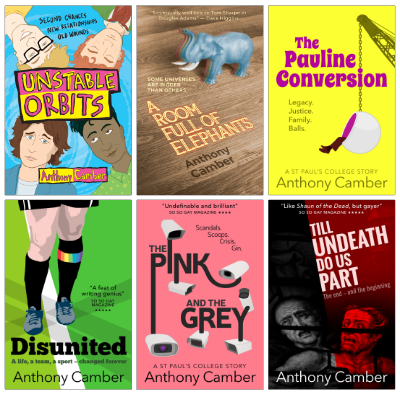
(April 2013 note: I used some of the ideas from the short story below in my novel Disunited, written as Anthony Camber.)  


“Come in.”

The door opened, wafting sparkles of dust between the slices of pale December light struggling through the blinds. He approached nervously, like a schoolboy summoned to the Head’s office. But I was the scruffy one, in a training kit smeared with the day’s mud, and he was wearing a designer suit. Too much bling.

“Sit down, son,” I said, tossing some unfinished paperwork onto the desk, with all the rest.

“Cheers boss.” He perched. I hate it when they perch, it means trouble. At his age he should be strutting and sprawling, I thought, flashing back to when I was eighteen. A different world. Back then I didn’t have his salary, that’s for sure. Or his talent.

“Well?” I was still the boss.

An awkward pause. Please, not a transfer request.

“I need to tell you something.” Like I said, he was perching.

“OK.” Keep it light. “Don’t worry, I’ve got Max Clifford on speed dial.”

That forced a weak smile, no more. He stared at his shoes and fiddled with a ring. Fine: the day’s schedule disintegrated in my head, which at least meant the paperwork could be forgotten for another few hours.

“It’s just…”

“Come on lad. What is it? A fight? Paps caught you in a nightclub? Got some girl up the wossname?”

“No!”

“Drugs? Listen, we’ve all done a little–”

“It’s not drugs. I’m not stupid.”

“A sex tape, then.”

“I haven’t done anything wrong.” His eyes blazed, the passion the fans loved him for, the passion that sparked into genius on the pitch. And now I knew there was trouble.

I was leaning forward – being confrontational, as usual. Bad idea. I forced myself to sit back, the leather chair creaking and crackling into the silence.

Calmly, despite my rocketing heart rate: “So tell me why you’re here.” I breathed slowly, deliberately, remembering penalties scored and missed, mine and others.

He hesitated. Mouth open and shut. A decision. Eye contact. “I’m gay.”

Freeze-frame for a second, or five. “I’m not in the mood for jokes.”

Another second. “No joke.”

“Because if this is a wind-up, I’ll–” I was forward again, agitated, visions of hidden cameras, Noel Edmonds, stupid gold-plated laugh-at-the-idiot-footballer trophies.

“Boss. I promise, no wind-up. On my mother’s life.” A pause, another choice made. “I’m not ashamed of it. It’s not a phase. And I’m not gonna hide it.”

I made a noise, some kind of neigh, as the air escaped my lungs. They didn’t cover this at the coaching academy.

Deep breath. Big sigh. I took in the room, not very fancy as these things go: desk, sofa, certificates, all seen better days. And photos of those better days, of a younger, clear-eyed me – shimmying round a defender, that look on his face; the cup-winning team, all scarves and smiles. Jeez, shorts were short then.

And here and now: a boy, no more than that, albeit a hugely talented, highly paid, coiffed and tailored one, perching – still perching – before me. A dust mote flashed in the light and I followed it, carefree, immortal, until it vanished in the shadows. I felt suddenly very old.

“No,” I said.

“Boss, I’m not joking.” I was quite sure of it.

“I don’t care. I will not allow it.”

“You can’t stop me.”

“No. I can’t stop you. I can’t stop you drinking, smoking, clubbing, and all those other things lads your age do. But when it affects your performance, the team’s performance, I can drop you.”

“You wouldn’t drop me.” Standard teenage arrogance.

“Try me.” His next line was knee-jerk, obvious.

“Then I’ll quit.”

This wasn’t getting us anywhere. Time for a different approach.

“Listen, son. There are no gay footballers. There’s a reason for that.”

“I’ve read all about it. Justin Fashanu, he was gay. He played at the top level.”

“One player. One. Who was abused, transferred. Cloughy knew what he got up to, kicked him out. He ended up killing himself, you know that?”

“It doesn’t have to be like that!” He was angry now. I should have tried to calm it down, but…

“That’s just the way it is, kiddo. Get used to it. Get a girlfriend. Get on with your life, forget all this gay nonsense.” Stoking the fire. I regretted it instantly, expected a barrage of abuse in return.

Instead he just laughed, the bitter laugh of a future denied. My head throbbed. I rubbed my temples, filling time, as no words came.

Quietly, he broke the silence. “It’s the twenty-first century, man. I just want to live my life.”

“I know.”

“Gareth Thomas, the rugby guy. He came out, no problems.”

“There was a bit of trouble, but… I know. But rugby’s a different sport, a different crowd.”

“Football’s not so different.”

My turn to laugh bitterly. “You’ve never played at Millwall.”

He grinned. The tension evaporated. Sunshine striped across his jacket, contours of light over his face.

I stood and adjusted the blinds. “You realise the first black players had bananas thrown at them,” I said. “They still do sometimes, despite everything. You still hear monkey chants.”

“People are afraid of difference. But difference is nothing to be ashamed of. No reason to hide away. The more black footballers, the better it got. The more gay footballers, the better it will get.”

“But to be first – it’s bound to affect your game. And the rest of the team.”

He shrugged. “Someone has to be first. I’ll sort the team out. I can do the tabloids, the TV, talk to the fans, get them behind me.”

“It’s not our fans you should be worried about.”

“Sure. But if Viv Anderson could do it, and Brendan Batson, and Laurie Cunningham, and Cyrille Regis, and all the others, including Fashanu, I can do it.”

“They couldn’t hide being black.”

“Damn right. And they didn’t want to either. They weren’t ashamed of being black, and I’m not ashamed of being gay.”

I had to admire his determination, and he knew his footballing history. He was full of surprises, this boy. But he was so young. Could he deal with the abuse when it undoubtedly came? The barracking, the filth, even the death threats? He was so young.

“Why now?”

“You telling me there’s a good time?”

Fair point. “But in a couple of seasons, when you’re more mature…”

“Boss. I’ve read the bio. You were married at 21, kid at 22, and no saint before that. I don’t want to hide away, skulk around in the shadows, spend the best years of my life afraid of being recognised or, worse, not getting any. It was different for you.”

I had to agree.

“And…” he hesitated. “In four years, there’s Brazil. I want to be in the squad. And I want my boyfriend there too, if I have one. One of the WAGs.”

I laughed at that. Footballers are always footballers. But he had more.

“And then in Russia in ’18, I might be married. And captain.”

“Christ, you’re nothing if not ambitious.”

“How do you think I got here, fancy clothes, flash car? I’d never have kicked a ball if I didn’t believe I could do it.”

“So what about 2022? With your attitude you might still be in the team at thirty. But you can’t be gay in Qatar. It’s illegal. You heard Blatter, he says gays should refrain from…” I waved my hand, he knew what I meant.

A look, a defiant smile. “That’s why I’m doing this.”

“I don’t understand.”

“Blatter doesn’t matter. He’s an old man. Old thinking, old ways. We make the world we want to see. If I come out now, be the first, stand up and be counted, be successful, others will follow. They won’t be afraid. It’ll take a few years, but by ’22 there’ll be dozens of us – out, international players. Whether I’m playing or not, I’ll be in Qatar. With a husband, and kids maybe. And I won’t be the only one.”

“It might still be illegal.”

“What are they gonna do? Flog us all? Kick us out?”

I looked at him, the man-boy, the heart of the team, the fire of youth. He wasn’t perching any more. He was right, damn him. He was too young, he was naive, he was hopelessly, recklessly optimistic, but he was right. At some point you have to make a stand. At some point you have to do what you know is right, regardless of consequences.

“OK,” I said finally, slowly, a plan forming. “OK. I’ll talk to people. Max Clifford won’t like it, though.”

“He can get stuffed.”

“Just… don’t say anything yet. Let me arrange things, get the timing right. You – you tell whoever needs to know before it all gets out.”

A grunt. “My family, my mates, they’ve always known. They’re like, whatever.”

I should have expected that by now. “Good. Right. Clear off. Keep quiet. Get ready.”

“I’m ready. Cheers boss. I’m ready.” He stood, face in the light again, as it always was, as it always would be. We shook hands with a smile and he left, flashes of dust billowing again in the echo of the closing door.

I drank in the silence, the room, the discarded paperwork. The rollercoaster of life. Still time to jump off. I picked up the office phone, hesitating over the keypad. A deep breath; time for penalties. I dialled the number.

“Hi darling,” I said. “It’s time for me to come out.”

Leave a comment

Filed under Random

Ming the Merciless’s gay twin brother

From the moment he stepped over the pub threshold I knew he’d be trouble, and I knew I’d be his target. Like a granny to an infant, at some point he’d be irresistibly drawn to me and would overwhelm my personal space, his face occluding all the known galaxies, his monster hands wandering uninvited.

He was tall, dark and loathsome. He hulked over the bar, scattering twinks like emo skittles. I saw one fatless wonder look him up and down – well, up and up, and down and down and down – and watched the poor youth’s expression shift from “oh?” to “oh!” to “no!” as realisation dawned.

It was, I swear, Ming the Merciless’s gay twin brother. A little more hair, a little less… imperial, but equally evil and certainly an imminent threat to all life on Earth. All you had to do was strike a match within six feet of him and watch the planet burn.

He spent many minutes prowling the pub, not so much undressing as eviscerating people with his vodka-laser stare. I thought I’d escaped when he loomed over Steve Hum and began delicate negotiations, like China in a bilateral with a small Polynesian archipelago. Steve, no shrinking violet, shrank and turned violet. But the guy moved on, course laid in for David Hale. My heart sank: I knew I was next.

I was on my phone attempting to rattle off a plaintive tweet for help when he sidled/sozzled up and enveloped me in a dense alcoholic drizzle. I would love to report what he said but his Eastern European accent was as thick and impenetrable as his leathery hide, and most of the discernable words refused to parse into anything resembling a sentence. He slurred something about “You have a brain,” with which I was forced to agree. He wanted me to look into his eyes for five seconds; I feared they would spin and spark and render me helpless in his gaze and I’d wake up on Mongo chained to his fox fur throne and dressed like the 1972 Blackpool illuminations, but nothing happened.

“Well, that’s your five seconds.” I returned to my phone to finish the tweet. He cursed my primitive Earthly device in an unfamiliar tongue so I adopted my grown-up-talking-to-child voice and said I needed to send a text. This quieted him, or at least confused him; and while his back was turned I darted away, like a gazelle from a particularly pickled lion, to the relative safety of the bar.

My freedom was fleeting. He spotted me and, by now at least six or seven sheets to the wind, tacked haphazardly in my direction. I made no eye contact, observing Lift/Urinal Protocol One. He bought a drink. In fact he bought two: he pushed one along the bar to me, or perhaps moved the rest of the planet in the other direction, I’m not sure.

“I’m sorry, I’m driving. I already have my one drink.” I smiled nervously, pointing at my Peroni and fully expecting a psychic burst to dash it into the slop bucket.

He leaned in close and slobbered in my ear. “You are very horny guy buuuurp.”

Nothing says classy like audible punctuation. Please, no colons or em dashes.

Behind the bar Alex stood watch. He caught my eye; it’s fine, I said. And it was, in a please-don’t-pull-a-knife kind of a way. I felt no actual threat or intimidation; he was too wasted to be anything other than an irritant, a large Lithuanian bluebottle – emphasis on the bottle – who needed swatting with a newspaper the size of Swansea.

But when he put one arm either side of me on the bar, pinning me there, a line was crossed. My mental Uhura flicked on the flashing red bulb. Enough was enough.

I told him to stop. It was the grown-up voice again. He released me from my drunken dungeon and then started on the “You think I’m ugly” schtick, to which there is no appropriate response, so I said nothing. Instead I turned to the bar staff: “Don’t serve him any more.”

And then he was gone – though sadly not in a puff of pink smoke and a thunderflash, or a poorly executed blue-screen effect. I think he went for a wee. For a time he drifted in and out of the pub, carving a boozy furrow between smokers and toilet; and then finally I sensed a great darkness had lifted. I debriefed with Steve and the bouncer.

“Has the scary man gone away?” I asked.

“I put him in a taxi to Niche or the Fez. Take him anywhere, I said, I don’t care. Just get him away from here.”

And so Ming the Merciless’s gay twin brother, Munt the Relentless, had gone on to terrorise another planet. We had defeated him.

But are we truly free of his mincing menace? Shall we again look evil in the gayface and do battle, twink, otter and bear united against his twatted tyranny? I know one thing: next time we will be ready. Next time we’re putting Queen on the jukebox.

1 Comment

Filed under Random

Tackling drink-driving by closing the M4

Last weekend saw political hammers and security service nails deployed once more to shoddily half-shut a stable door. Next, with best misery guts faces on, a succession of suits will assure us that adding CCTV to all stables and waving our hands in an expensive pattern are crucial to ensuring our safety, despite them all having ignored the gaping, yawning doorway since the stables were opened by the Queen Mum in 1964. Meanwhile the escaping nag – Yemeni Ink, by Timing Device out of Sniffer Range – canters leisurely to pastures new.

It must be party time in Osama’s cave/hotel room. Again we see that al Qaeda doesn’t have to kill people to win. Terrorists, some people appear to have trouble grasping, aren’t actually trying to kill people: they’re trying to spread terror. And with the eager, hysterical assistance of the media and the government they’re succeeding. The Sunday Express shrieked about “Lockerbie II” and pols everywhere are now scrambling to be seen to do Something, Anything. Paint the stable yellow! Put a low brick wall around it! Place it inside an invincible glass dome with no way in or out! Blow it up!

This is, of course, all part of Osama’s plan to put the willies sufficiently up western democracies to make them overreact to each and every perceived threat, to keep the populace in a state of constant fear and suspicion, and to tacitly incite hatred against anyone not like them. It’s Operation Chief Inspector Dreyfus: make us all twitch-eyed, trigger-happy gibbering nutjobs intent on destroying all the many Inspector Clouseaus of our respective lives.

And so far Operation Dreyfus appears to have been a wild success. It seems half the US population is spooked by the sight of a muslim. Given the reaction he seems to be producing, I’ve noted with some concern that nobody has ever seen Glenn Beck and Osama bin Laden in the same room.

Operation Dreyfus is Act II of Osama’s grand plan. Act I, of course, ended on September 11, 2001. For the last nine years we’ve had a steady stream of lower level attacks, some foiled, some not. They’ve kept governments and security services busy poking around empty stables with long sticks and declaring war on straw and other nonsense. But have they been so busy chasing their own tails that nobody has been focusing on two rather important and interesting questions: how does Act II end? And what happens in Act III?

Act II is building steadily to a population conditioned to live in fear, to expect and find normal the constant, draconian surveillance of an increasingly authoritarian police force. Last year 100,000 people in the UK were stopped under anti-terror laws, sometimes for photographing public buildings, but a grand total of zero were arrested for terrorist offences. Travellers in the US are forced to choose between inspection by all-revealing scanner and by TSA hands instructed to wander crotchwards until they ‘meet resistance‘. And meanwhile, the steady rise in paranoia: posters exhorting you to Report, to Keep Watch. Terror Threat Levels. Reassuring-but-subtext-laden statements – “No information of any imminent attack” – designed to convey the message IMMINENT ATTACK!

And anyone too Different – in skin tone, or religion, or assumed religion, or lack of religion, or extent of trouser flare, or angle of fringe, or anything else that can be imagined – lives in fear. Watching their backs. Worrying who’s round the next corner fleeing the latest Fox News falling sky alert.

That’s where I suspect Act II ends: hunter and hunted. Possibly an innocent muslim lynched by a baying, slavering mob, an ensuing riot, tension, panicky cops: and then the shooting starts. Touchpaper well and truly lit, it kicks off elsewhere too. Curfew, state of emergency, troops deployed.

Once a country is in that heightened, nervous, fidgety state, the tiniest action is incendiary, like flicking a tiddlywink down a mountain. Once the avalanche has started it’s too late for the pebbles to vote. Act III probably opens with such an event: a simple, game-changing act. My first thought was an assassination, but a kidnap would be far more powerful. For the avoidance of doubt, this is purely a thought experiment.

Implausible, perhaps. But then I never expected to see the Berlin wall fall and Germany reunited within a year; to see an attempted coup in the Soviet Union, and to see that superpower rapidly disintegrate; to see a war in Europe; to see passenger jets used as missiles; to see western democracies engage in a war under entirely false pretences; or to see Greedo shoot first, and R2D2 and C3PO advertise Currys.

It almost certainly won’t play out that way: Osama might have very different goals for his three acts. I do know that we’re reacting to these events in precisely the way he would predict, and that’s where the problem lies. We invariably respond by trying to protect against yesterday’s attack in an overbearing and cackhanded fashion: like tackling drink-driving by closing the M4.

If the state truly wants to make us safer, then it should pour money into reducing road traffic accidents, not into intercepting and analysing internet traffic. It should say Keep Calm and Carry On, not If You See Something, Say Something. We in turn should laugh and joke about it, not let a git in a cave dictate how we lead our lives: we should simply refuse to be terrorised.

Terrorism is nothing new. We had IRA attacks on the British mainland in the 1970s, 1980s and 1990s. Some people were spooked by anyone with an Irish accent, but we didn’t declare a war on beer just because a couple of pubs were blown up. I remember turning on Breakfast Time in 1984 to see Norman Tebbit being pulled out of the wreckage of the Grand Hotel in Brighton, but receptionists didn’t suddenly start feeling people up before handing over the room key. If my grandparents, and millions of others, could remain in London and other major cities when the bombs were dropping during World War II, then we in our cosseted, cosy, ridiculously safe lives have absolutely nothing to worry about.

Leave a comment

Filed under Random

Travelling through space and time

The coach tour took us past the Saturn V: a Giant Redwood prematurely felled, rotting slowly on its side in the damp Florida heat. An unmissable reminder of Nasa’s glory days, then already a decade and a couple of culture shocks past. This one had been built to fly, before Nixon hacked off Apollo’s tail. Apollo 18, or 19, perhaps. It was a monument to success; a symbol of decline. It lived and died for politics.

Not far away, a forest of earlier launchers; still standing, once mighty, now mere saplings. Saturn V engines scattered like mushrooms. Gleaming, wasted mushrooms.

And the Vehicle Assembly Building. So large, I never tired of saying, that clouds formed inside. Down one side, a giant Stars and Stripes. Down another, a massive door, now closed. And inside, I told my Dad, was Columbia. At least that’s what I believed and hoped. I imagined it already hitched to its huge white fuel tank, twin SRBs either side, white-suited technicians crawling all over. I desperately wanted to see it. To see it launch. To launch in it.

A large digital clock confirmed that a launch was a few days away – but not Columbia. The orbiter’s maiden flight was beset by delays, thousands of new systems and processes to build, and test, and shake out – with no Kennedy deadline to meet. The shuttle would be a workhorse, we were told, a quick and cheap route into orbit. They wouldn’t be planting any flags, they’d be supplying a service. A launch a week, said the PR. A fleet of orbiters. I couldn’t wait. We might actually have 2001 by 2001, I thought.

With Nasa’s future cloaked inside the VAB, the tour showed us more of its triumphal past. The Apollo 13 Command Module, success grabbed from the jaws of defeat. An unused Lunar module, another of Nixon’s casualties. Battered training units to clamber over. A wooden lunar rover to pretend to drive. Actual moon rock.

Finally we boarded the coach back to the hotel. A long drive into the setting sun; an undercurrent of travel sickness always threatening to bubble up.

Thirty years on almost to the day, that journey back sums up Nasa’s fortunes. Then, we looked forward to the first shuttle launch. Now, we simply hope that the ageing fleet, two orbiters lost to mismanagement and capricious fate, makes it through the remaining few launches intact to join the Saturn V and its forebears in the museum. Nothing dates as fast as the future.

As in 1980, the Nasa of 2010 is at a turning point. The shuttle programme never delivered on its promises – too much pork, too much CYA, ‘reusable’ orbiters virtually rebuilt between launches – launches themselves costing $500m a pop. But there’s nothing to replace it.

It’s 38 years since men last walked on the moon. Since men last left Earth orbit. By the end of next year Nasa will struggle even to put people into Earth orbit without paying others – Russians, for the time being at least.

This isn’t the future I imagined, as I stood in my short shorts leaning non-nonchalantly against a rocket engine in the October sunshine.

And what future do I imagine now? Where will we be in October 2040? That’s assuming we survive Y2K38, and assuming we’re not all living on rafts or in caves or inside the Matrix or rebelling against our robot overlords or fighting the undead.

Here’s my guess. The US, long divided internally, will likely be two or more independent republics squabbling over once-settled state borders, desperate for oil, struggling in a changed climate. If not underwater, the Kennedy Space Center will be pure museum: the future long past.

But it wouldn’t surprise me to see a presence on the moon. Chinese, of course.

1 Comment

Filed under Random

Croatia

Ah, holidays. One minute you’re anticipating a week of sun and relaxation on the Dalmatian coast, the next a friend is screaming in agony after slipping on some wet steps and badly breaking her leg. Melanie has form, but twelve hours into the holiday is a new record.

For future reference, the Croatian for 999 is 94. Not that we knew that at the time. We soon learned that most of Split, the closest city, is a grimly post-communist forest of tower blocks with a cheap and efficient – and grey and understaffed – A&E. Happily they did a great job of straightening up Melanie’s zombie foot in a flight-ready cast, then turfed her out into our waiting people carrier for a hellish journey back to our villa in a Croatian monsoon.

Chris spent the rest of the evening speaking to insurance droids on hideously expensive phone calls. He thanked one American lady for her help, who replied, “Just doing my job, sir.” With a straight face Chris answered, “All the heroes say that.” Thankfully he hung up a few seconds later so that we could all burst out laughing.

Chris and Melanie flew home the following day. The rest of the holiday was significantly less eventful.

We had rain, and lots of it; we recreated scenes from Doctor Who; we ate identikit cheap food, in the main; we visited a national park and its stunning waterfall; we saw Roman ruins; and so on.

My photos (and the Doctor Who photos). See also photos from Louise, Chef and Lynda.

(Melanie, incidentally, had a couple of pins and a plate inserted in Addenbrookes and is now home, being attended to by nurse Chris.)

3 Comments

Filed under Random

Pilgrimages

Scott Pilgrim versus The World is unquestionably an Edgar Wright movie, in the style we know from Spaced, Shaun of the Dead and Hot Fuzz. Background treats! Easily missed visual and aural gags! Pop-culture references! But no Simon Pegg or Nick Frost. It’s an Edgar Wright movie without the usual suspects: but is it a Carry On Columbus, notable only for the cast not present?

Happily not, matron, oh I say, hwahwahwah, etc. In fact it’s the closest I think I’ve seen to a comic-book-slash-graphic-novel in live-action movie form. I have yet to read the books on which the film is based – mainly due to the incompetence of the Home Delivery Network, a rant for another time perhaps – but, like Watchmen before it, I have the distinct feeling that many of the scenes are lifted substantially unchanged from the source material; storyboards barely required. But perhaps I do Wright a wrong; I’ll see.

The film’s flaw is also what makes it great, for me: as well as being a film-o-comic it’s a film-o-game. Video games and gaming culture are at the core of the story. Those not steeped in the lore may well emerge bewildered – if they stay to the end of the film, which three people at my screening did not. However, gamers should love it: it’s the first mainstream, big-budget film I’ve seen to get the essence of gaming culture right, to feel like it’s been made by someone who has actually played a video game, rather than portraying a hackneyed, Hollywoodised variant thereof. It’s like the first western to include a horse.

I’m a fan of Michael Cera, who plays Pilgrim. Or rather, I’m a fan of the character Michael Cera played in Arrested Development, George Michael, which is no more than a smidge different from the character he played in Juno, and barely an insect’s toenail from his portrayal of Pilgrim. I presume he can play other characters, but in this case I’m glad he didn’t.

But it’s Edgar Wright’s film. Now: please can we have the third in the cornetto trilogy? kthxbai.

Avaragado’s rating: assorted power-enhancing fruit

Last Friday His Holiness Stephen Fry graced the Corn Exchange with his wise and illustrious visage for ninety minutes of chatter and readings from the new volume of his autobiography, The Fry Chronicles.

Fry is of course a national treasure; not quite at Thora Hird levels but then she did have the stairlift. In the talk he told how it nearly didn’t happen – two ‘hinges’ in his life, as he put it, that might have swivelled differently and led to a very different personal history. This is true of everyone, naturally – we are each the sum of our decisions, both micro and macro – and I can identify a couple of hinges in my own life, similarly seminal in moulding the modern me. One of them was undoubtedly the chance meeting I wrote about recently that set me along the computing path. I occasionally wonder how different my life might have been had that meeting never happened. In a parallel universe I might very well be an HGV driver with an intimate knowledge of overhead camshafts.

Fry’s retelling of his first meeting with Hugh Laurie at Cambridge, how they started writing together with virtually no preamble, no getting-to-know-you stage, was fascinating. Almost like love at first sight, he said. It made me want to read the autobiography, which was after all the point of the evening. And it made me want to write more, which most things seem to do at the moment.

Attendees were granted individual audiences with Stephen post-show, assuming they had crossed the palm of the man from Waterstones (Gary) with silver and bought a book to sign. A health-and-safety worryingly large number of people did so; it was impossible to distinguish queue from non-queue. The call of B Bar proved stronger and we high-tailed it out of a side door.

It strikes me that the blessed Stephen’s life is ripe for a BBC Four drama-documentary someday. It’ll happen, mark my words.

Avaragado’s rating: bon-bons

Oh, and the Pope popped in for a visit.

I’m not a fan.

Leave a comment

Filed under Random

When Harry Secombe attacks

Living in the future is amazing until you have to visit the past. In the past, people had to arrange to meet in advance. Only buildings had telephones, even though nobody wanted to talk to a house or an office. News was disseminated either by dead tree or by Kenneth Kendall at 9 o’clock. Everybody dressed oddly. The music was, though, much better. Songs had words, now it’s just noise, etc.

Walking into a bank brings back that Eighties feeling – just whitewashed with nicer hair, shrubbery and Helvetica Neue. Worse, there’s still a sense that the back office is ruled by a fat man with mutton chops, perhaps played by Harry Secombe, inscribing all transactions using the world’s featheriest quill in a ledger bound with the skin of an entire parish of cows. “Mr Hardworthy? I should be obliged were you to release funds to the value of 3/- to allow Mrs Blenkinsop, a fine and upstanding gentle-lady the size of Wigan, to purchase an ugly hat.”

Mrs Blenkinsop was ahead of me in a bank queue a few weeks ago. The bustle gave it away. She was using it as a parcel shelf.

I’d ventured into the past to close an account that was earning a massive 0% interest and move the money into a new account that would earn me a much better rate, like 0.5%. A simple job, you might think. You might reasonably expect some kind of precedent for this task, perhaps even a well-tested procedure.

And you’d be right. I was attended to courteously and efficiently by a gentleman evidently of a similar nature to myself, deft with the mouse and familiar with the hellhole of cascading popups that seems to constitute banking systems. Account closed, money transferred. Now please sign this piece of paper.

Head office, it appeared, needed some physical authorisation: my presence in a branch, one might even say my biometrics, apparently being insufficiently physical. Two-factor authentication – my card and its PIN in my head – ignored in favour of the single-factor analogue scribble of my signature.

The Time Warp, from Rocky Horror, started playing in my head. It seems Harry Secombe worked at head office instead.

Ah well. Processes, eh? Pfft, tch, etc.

And then a few days later a letter arrived from the bank. “Some important news about your recent letter to us,” it began patronisingly. My signature, I was told, didn’t match their records. I hadn’t sent any letter to them: everything was done in-branch. The scrawl on the form apparently didn’t match the pristine, young person’s signature I’d invented on the spot when opening my first bank account with them aged 16. Not altogether surprising. I was annoyed, though: I’d been in the branch, authenticated by card, pin and gay. Was that not enough?

I returned to the same branch a few days later, The Time Warp now on brain-repeat. I waved the letter in front of a man, who apologised and scurried about making copies of things. It’s just a jump to the left. And then a step to the right. All done, he said. OK: that was easy.

A couple of weeks later a short conversation with a cash machine led me to believe all was not as it appeared. The account I’d supposedly closed used to regularly suck money from my current account into a savings account; the new one didn’t. But it was obvious from my balance that money had been recently sucked.

My first thought: it’s gone into a black hole. They’ve closed the account but not the suckage. If not that, then they haven’t closed the account at all.

I went to the branch again. Helpfully I spoke to the advisor who’d tried to close the account originally. He remembered me. With your hand on your hips. You bring your knees in tight. We went through the account closure process again – the sucked money wasn’t in a black hole, thankfully. I signed the form again. We tsked and pffted about processes and head offices again. It was Groundhog Gay.

And then a few days ago, I received a letter from the bank. “Some important news about your recent letter to us.” I was shocked, shocked I tell you, to discover that – you’ll never guess – my signature didn’t match their records.

Three attempts so far to close an account. Several weeks doing lengths in the custard pool, unable to overcome the drag of Harry Secombe’s sideburns.

Later today I’ll make another trip into the past, to queue with Mrs Blenkinsop, her bustle and her new ugly hat, to discover what excuse they’ll offer this time. I could threaten to withdraw all my money and go elsewhere, but I’d only get another letter failing to recognise my signature. This time I have a secret weapon: this time they get the pelvic thrusts.

Leave a comment

Filed under Random

What’s past is prologue

The queue pushed and swayed, a dozen or more excited school kids chattering about what lay behind the door. It was early September 1980 – the first or second week of term, my first term of secondary school. I queued with a friend from many years before who I’d bumped in to again a few weeks earlier. He’d told me then that he’d been learning about computers. I’d never used one; they sounded interesting. The queue was for Computer Club.

Behind the door, eventually, we found two computers: a Research Machines 380Z plugged into a large black-and-white TV on a trolley and with a keyboard seemingly made of wrought iron; and a Tandy TRS-80 with a green-screen monitor, an altogether sexier beast. Model I, Level II BASIC, 16K RAM. Pixel resolution of 128×48. Tape storage. No lower case characters. Awesome. The potential! The thrill!

We sat on the playing field afterwards, the school dozing into silence for the evening but the two of us buzzing.

“I want to learn how to program,” I said.

“I’ll lend you a book. I’ve written some programs already. Easy really.”

“What do they do?”

“One does hangman. In theory. It’s only on paper, but it looks right.” He didn’t have a computer yet.

“You going to sell it?”

“Not this one. I have plans though.”

“Breakout? Space Invaders?” The TRS-80 wasn’t capable enough for Defender, that much was obvious.

He paused, and rubbed his face all over in that way that he had. “Tell me about the future.”

“The Space Shuttle!” Columbia’s maiden flight was due in a few months. It had already been delayed several times. I was a little obsessed.

“An evolutionary dead end.” A wave of the hand, dismissed.

“A flight a week, NASA says, and–”

“Not gonna happen. They have to say that to get the money. But I’m talking about computers. What will they be like in five years, ten years? Thirty?”

I was eleven. Five months was a long time. Five years? ‘O’ Levels, I guess. I’d probably have a girlfriend. Ten years? Thirty? No idea. Oh – I’d have a family, and a moustache. That’s all I knew. A thought struck. “Positronic brains. The Three Laws of Robotics. ” Asimov was another obsession. “C-3PO, human-cyborg relations.” And Star Wars.

“So compared to the TRS-80?”

“Much more powerful: smaller, faster, intelligent.”

“Smaller, faster, but not intelligent. And add ‘cheaper’.”

“Smaller, faster, cheaper. Is that it? No robots?”

He paused again, longer this time. It was getting chilly. The tall trees bordering the playing field caught the breeze and danced. He turned towards me, pivoting his whole body on the grass. “Let’s talk about evolution.” I hated it when he changed the subject like that. “What happened when the first life evolved to survive on the land?”

“They took over. They had the place to themselves. Plants, insects, amphibians, reptiles, rarrrrgh!, birds, mammals, Thatcher.”

“Wave after wave. More sophisticated species replacing or dominating or eating less sophisticated species. More or less. A food chain. Symbiosis. Co-evolution.” I barely understood the words he was using. I realised he’d been learning about more than just computers. “Bees and flowers, hunter and hunted, even humans and dogs.” He was excited and gesticulating now, eyes bright in the gathering gloom. “All it took – all it took – was a foothold. A trailblazer. A simple species making an adventurous leap.”

“I see.” I didn’t see.

“That TRS-80, that 380Z.” Back onto computers again! Christ! “They are the trailblazers. The algal scum clinging to life at the edge of a Paleozoic pool.”

“Oh, I see!” I saw. And I wished I could talk like that.

“They are the… the quantum leap. In five years much more sophisticated species of computer will exist. An explosion of architectures, of forms.” He spoke too fast for his mouth, flecks of spittle leaping free. “Faster, smaller, cheaper. Colonising homes like lichen, moss, plants, flowers. And where you have plants, you have pollination – and eventually pollinators, like–”

“Bees!”

“Which in computer terms, means…”

“Taking pollen from one computer to another. Moving stuff around. Computers that talk to each other!”

“Exactly. Exactly. And we already have those. Heard of Prestel? And at airports, they type your name into a terminal that’s connected to a central computer. Universities have these networks too, linked all over the world.”

This was news to me. “The bees are already here.” Buzzing indeed.

“Simple bees, yes. Wait a few years – ten at most – and they’ll be faster, more agile. Then eventually birds, swooping and soaring, the networks going faster even as the plant computers grow more powerful.” That glint again. “Ever more connected, through wires and radio waves, and located by satellites. Millions of times more powerful, millions of times faster, everywhere in the world. And they all merge – the bees and the birds and the mammals including us humans are all computers too.”

The analogy exploded in my head. “But what do you mean, humans? Bees and pollen, networks, yes. Humans?”

“Simple designs but complex, cascading, unpredictable effects. Bees do a couple of things well, birds more, humans much much more. You reach a point where it all grows exponentially, the sophistication of huge brains interconnecting over what is really a very simple system. At its core, deep down, we’re all just hyper-mega-intelligent cylinders of flesh.”

“Ah, right! Of course! So this global network of the future, then, is really just an enormous, interconnected… series of tubes?”

Leave a comment

Filed under Random