Tag Archives: Bletchley Park

Remembering Alan Turing

After the Great Fire of 1666, Sir Christopher Wren rebuilt St Paul’s Cathedral and much of London. Three centuries later St Paul’s still stands, still dominates the skyline, despite the needles and vegetables and distended pyramids that have grown up since.

The Tower of London, St Paul’s Cathedral, the Palace of Westminster, Tower Bridge, the London Eye, the Gherkin, and now the Shard. Familiar shapes, instantly recognisable silhouettes. Over nine hundred years of architectural history.

In 1676 Sir Isaac Newton wrote to Robert Hooke: “If I have seen further it is by standing on the shoulders of giants”. As in architecture, as in science. The tower of knowledge grows ever faster.

We are surrounded by computing power orders of magnitude greater than took man to the moon, which was itself orders of magnitude greater than helped break Enigma and Lorenz/Tunny.

In seventy years the computing skyline has leapt up: the buildings ever taller, ever shinier, and topped with ever louder bells and ever shriller whistles.

But the work of Alan Turing still dominates. A century after his birth, and almost sixty years after his death, his achievements are still discussed and lauded. Turing is the Wren, the Newton, of computing.

Wren lived to 90. Newton lived to 84.

Turing lived to 41.

He died, ultimately, at the hands of a state he helped preserve.

What might Turing have achieved had he lived as long as Wren, to 2002? How might the world be different today?

How might the world be different had he taken his life before the war?

There are petitions online urging the government to pardon Turing, and to put him on the tenner. Both worthy, both insufficient.

We should remember Alan Turing through education. To ensure that we can produce more like him, who can stand on his shoulders and make new breakthroughs in maths, in computing, and in other sciences. And to remind people that bigotry and inequality, whether by person or by church or by law, have no place in society.

In St Paul’s Cathedral, inscribed in a ring of black marble beneath the dome, are the words “LECTOR SI MONUMENTUM REQUIRIS CIRCUMSPICE”. An epitaph to Sir Christopher Wren — and quite apt for Turing too, I think.

Reader, if you seek his monument, look around you.

2 Comments

Filed under Random

On loan from the future

My previous blog post lit up the zxdar of one of the good citizens of World of Spectrum, Gerard Sweeney. A flurry of emails later and The School now has its own entry in their database, as do your humble author (hello!) and the game’s co-creator Dave O’Neill. Gerard kindly produced a less bulky TZX file, as mine was apparently just a sample dressed up with a bow and pigtails. You can now download this version from the game’s page on World of Spectrum. Achievement, as the kids say, unlocked.

I’m also told that my Spectrum, serial number 001-000046, is very possibly the earliest still known to exist.

The 46th ZX Spectrum

S Mind blown, 0:1

I mean, I’ve always believed at most 45 machines could have tumbled off the production line before mine — that much makes sense. But I’d never given a deal of thought to the notion that all 45 might have become landfill or otherwise returned to component form. I assumed that 001-000001 would be under glass in Sir Clive’s penthouse suite, which as we know is made from the dismembered carcasses of old C5s and decorated with photos of Chris Curry pricked by infinite darts.

But if mine is the earliest, then I now have one of those pesky responsibilities.

I can’t pretend I don’t feel a manly breeze of vindication about this, in fact almost chest-thrustingly self-righteous and proud. Like those at World of Spectrum I am passionate about the preservation of our computing heritage, and our technological heritage in general. Too often these things are seen as ephemeral, as mere fashion. DC-powered shoulder pads. Here today, gone tomorrow, like not enough politicians. But this is why early comics like Superman #1 or Batman #1 or of course Captain Britain #10 are so rare, and so valuable. Why should technology be any different?

It’s one of the reasons I still have, I think, somewhere, I hope, almost all the tech the family bought in the seventies and eighties. I wish I’d been able to keep all the magazines too — but when my parents downsized a decade or so ago I bade many piles a tearful farewell (I couldn’t store them all at mine). Sadly I think they were all recycled. I did keep those issues I considered interesting or important or milestones: I should hunt them down to see if they’re rare yet. I suspect not.

Organisations like the BBC and NASA have a similar but different responsibility to preserve material: our culture, and our discoveries. The constant churn of storage formats and file formats means you can’t just store tapes: you need to store and maintain the players too, and code that can read the files, or have a rolling upgrade programme with all the comedy potential for error and loss. We can’t assume that future generations will reverse engineer everything we leave them, should the data even physically cling on to whichever media it was entrusted to. It’s a sad truth that the most durable form of much of today’s data is still (the right sort of) ink on (the right sort of) paper.

Forty years of removable storage

There’s a fascinating series of videos from the BBC’s R&D team about the challenges they face with archives. Some newer storage formats are less easily read than old film, such has been the pace of technological progress.

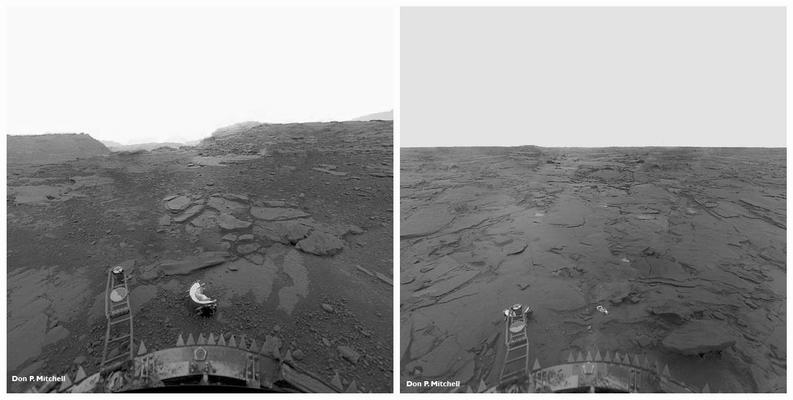
Occasionally this need to preserve — or desire to make public — old data brings surprise benefits. Touching the originals means you can process them in ways not perhaps feasible when originally produced. For example, the American researcher Don Mitchell was able to access original Soviet space mission records from the 1970s — and produce amazing new/old images from the surface of Venus.

But if you don’t have the original tape (or disk, or…) or you don’t have a working reader, or (to a lesser extent) the file format is unknown, you’re stuffed. The data is gone. See also: backups.

The technology industry is now old enough to need historians. In truth it has been for a long, long while. It’s nothing short of scandalous, in hindsight, that neither Colossus nor the Bombes — and not even their designs — were preserved for history after World War II, as far as we know. (I wouldn’t be surprised if GCHQ holds more than it publicly admits — it did recently release an unknown paper by Alan Turing.)

Thankfully, organisations like Bletchley Park and the Computer History Museum now recognise the importance of this issue. World of Spectrum realises it. NASA and the BBC are spending fortunes to stand still, because of it.

Maybe I should write an ebook about it.

3 Comments

Filed under Random