Disco statues and Michaelangelo Harryhausen

Florence is a sprawling mess of a city. Generally scruffy and overcrowded, it seems to consist of a few priceless jewels and a surfeit of German tourists.

It’s kind of like London: a city city. Unlike Rome, which is a world heritage site masquerading as a capital city. Or Cambridge, which is technically a city but is in truth little more than a machine in the service of the university.

Around and about Florence today we saw: a pig-ugly railway station (we parked nearby); some gobsmacking but not exactly understated architecture (the duomo); a comedy bridge (the Pontevecchio); several dusty side streets (in search of food); and a piazza looking like Ray Harryhausen’s props cupboard, full of amazing statues.

One of these is a copy of Michaelangelo’s David (the original is in a gallery we had no time to visit). Apparently I’m named after the statue – the real one not the fake. I confess I can’t see any resemblance. I’m the better-looking, obviously, but maybe an inch or two shorter.

We also ticked off the Uffizi gallery: a job lot of paintings of Madonnas with brats (not from Africa) plus a few instantly familiar pieces such as Botticelli’s Birth of Venus (bird on clam shell). You could tell the famous ones easily enough: they were enveloped by tour groups like nesting bees and barely visible behind over-reflective protective glass. I don’t know why they don’t just put up photocopies, most people would be none the wiser. The Queen’s a photocopy, you know. The real Queen is made of porcelain and too fragile for daily use.

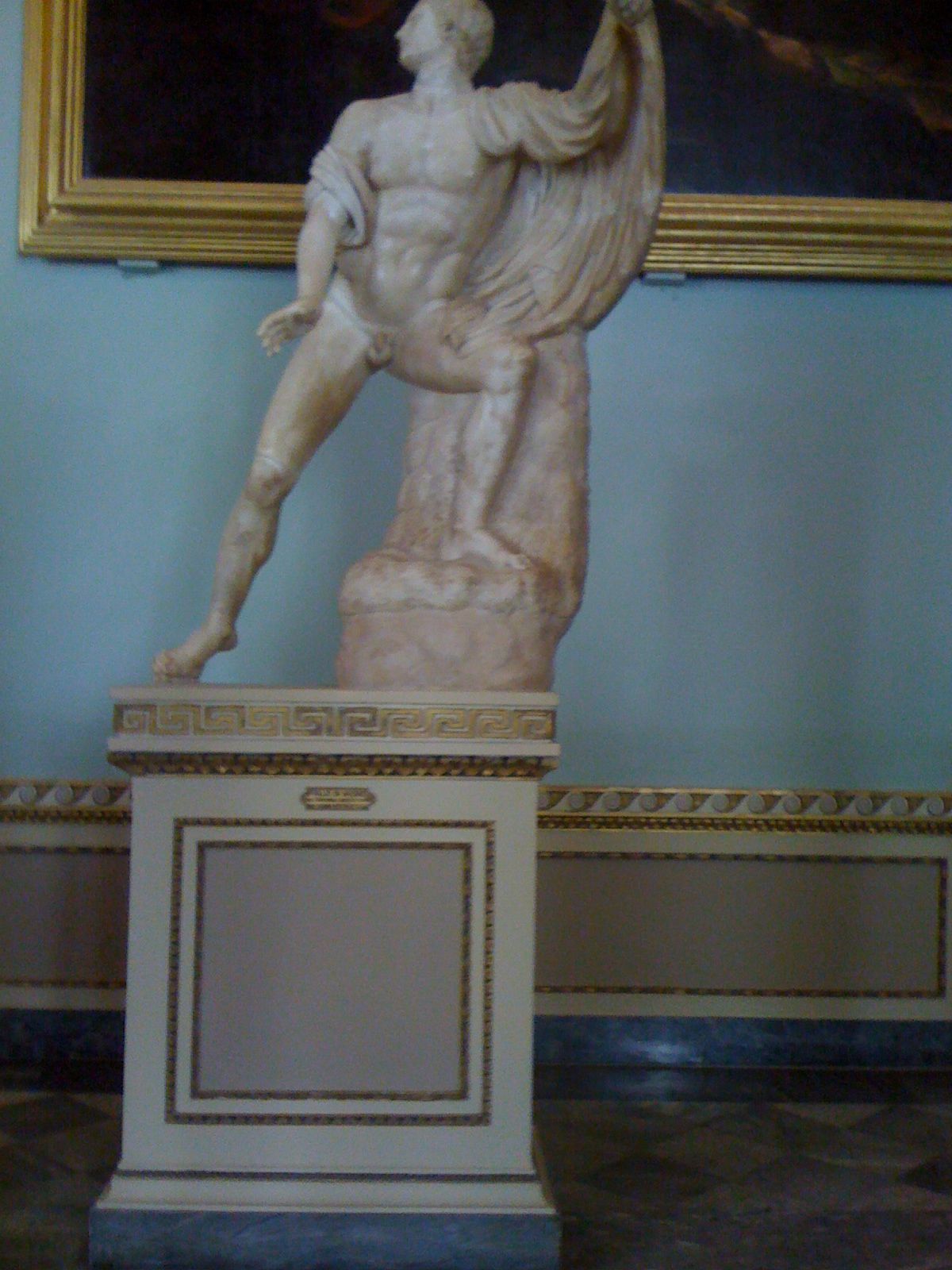
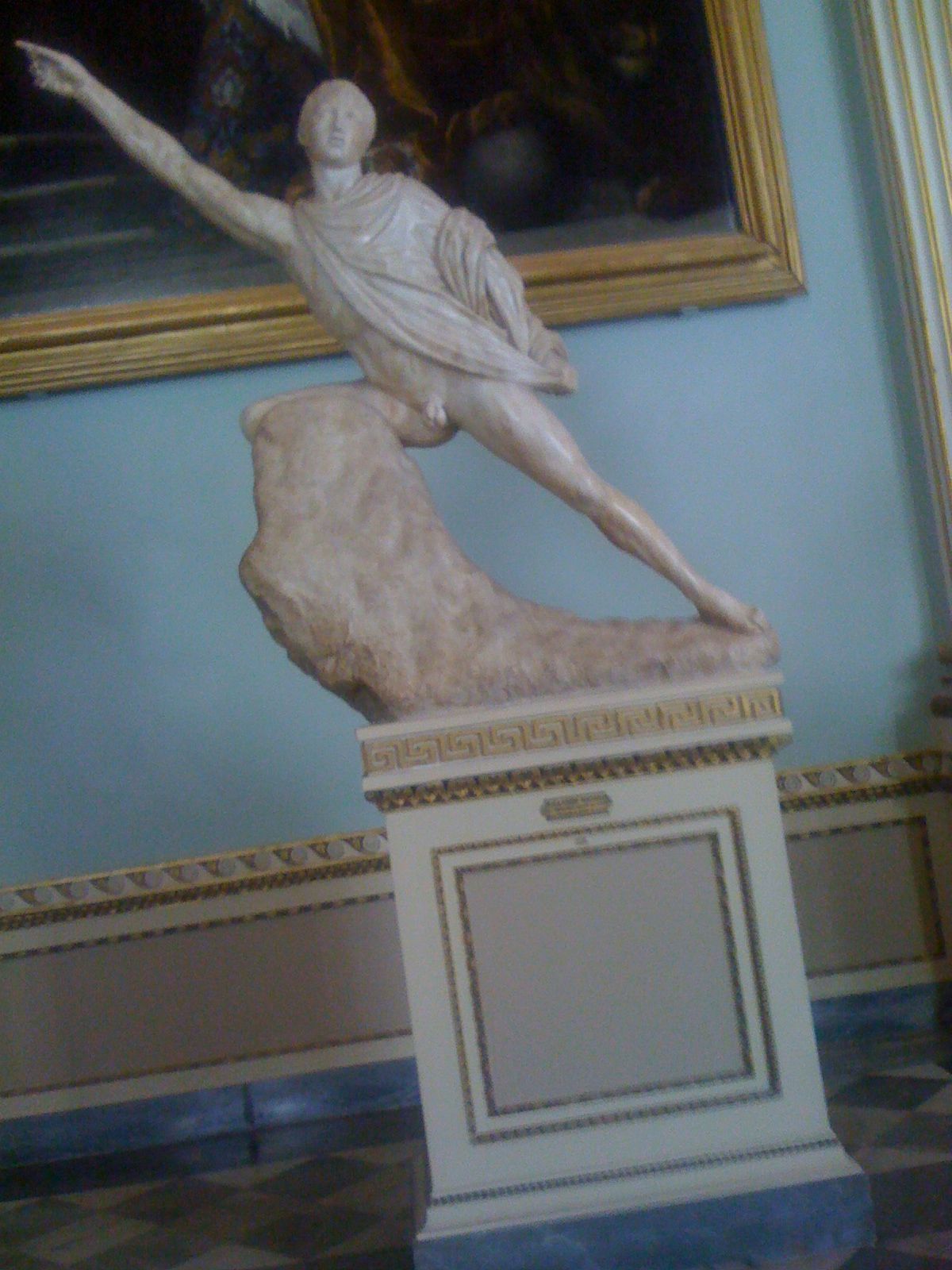
Also at the Uffizi, amusingly, a room of disco statues: a cross between the Doctor Who episode Blink and Saturday Night Fever. Photography was banned, so I took a couple. They may or may not be attached in some way to this post.

Leave a comment

Filed under Random

Icebergs, dead ahead

Bracing, that’s the word. Bracing. No it isn’t. Arctic. That’s a better word. Arctic, with a hint of polar.

It’s our villa’s swimming pool. So tempting after an hour or two on the Tuscan griddle, yet icy enough to cause all manner of breaths and oofs and oaths and screeches once the water tickles above the knees.

The trick is to get in and keep getting in until there’s no more in to get. Dangling a tentative foot, taking your time, easing yourself in, all these leave enough wiggle room for your body to talk you out of it.

Yesterday I managed fifteen lengths (the pool’s about 12m) before my body started shutting down inessential services and my fingers turned yellow (I have the circulation of the M25 on a bad day). Today I achieved twenty lengths, at least one of which was accompanied by a heat-seeking guided beetle of some kind. Not coincidentally that was a length swum freestyle. Bit of front crawl, bit of backstroke, bit of gay flap.

I doubt I’ll keep up this rate of progress. I am by no means a fast swimmer, despite my otter-like nature, and I think I’d be in danger of icing up after about 30 lengths. I don’t want to end my days a danger to shipping; or worse, Leonardo di Caprio.

1 Comment

Filed under Random

A Tuscan raider writes

My first flight was in 1975. I was six (that very day), had long blond hair and was mistaken for a girl. The whiff of airplane fuel sends me straight back: the excitement of a glimpse of Concorde’s nose through a window, the Stepford stewardesses with rictus grins and rictus hair, the choking cigarette smoke recycled constantly through the cabin to avoid a trail like the Red Arrows but made of cancer.

The modern airport machine still whirrs, with added security theatre and subtracted liquids. We still check in, though Ryanair calls it “baggage drop” and makes you print your own boarding cards at home. We still dutifully submit ourselves to X-rays and metal detectors, with ever-increasing intrusiveness, ceremony and general pointlessness.

Our flight to Pisa, for a week in the Tuscan sun, required us to endure a couple of hours in the company of budget airline Ryanair. No frills indeed: not even a seat pocket, and I guess the constant aural advertising and trolley shopping constituted our in-flight entertainment. They even sold smokeless cigarettes.

But a seat-back sign told me, along with pictographic and implausible escape instructions, that I could make and receive phone calls on the flight. I resisted the temptation, for I would only have texted or tweeted or bellowed “I’M ON THE PLANE” like a gurning poltroon. I nearly did it anyway, like the excited, blond, girlish six-year-old I still clearly am.

A few hours later, after nearly an entire orbit of Pisa, a close encounter with a kerb that may return to haunt us, plus a visit to a Tuscan Tescoalike, we found our villa. It is most acceptable. We may already need to buy more wine.

Leave a comment

Filed under Random

District 9

Honestly, I had intended last night’s novella to be a brisk lead-in to one of Avaragado’s celebrated film reviews. I, uh, wandered a bit. Approximately 1500 words of bit. Once I considered that homework and spent hours in front of 1980s TV pretending to write essays that long. Now I do it for fun. Good, wholesome, cathartic fun.

The film I’d intended to review was District 9. On the surface a film about aliens and how we’d deal with them if they turned up unannounced, it’s actually about prejudice: hence the connection with my previous blog. The aliens arrive (in 1982) helpless and easily subjugated, unusually for the science fiction genre, and by 2010 when we pick up the story they’re kept in townships (hence the film’s title) just outside Johannesburg in South Africa. You don’t have to dig deep to spot the analogy; it was filmed in real townships.

It’s a curious film. The first part is presented as a documentary, watching bureaucrat Wikus as he leads his team on a project to relocate the aliens – nicknamed “prawns”. When things go wrong we switch to an objective camera perspective for the fun and games that follow. It’s a mix of genres: part buddy movie in places, often gruesome and gory, but never more than a beat away from comedy or pathos. Lovely swearing too.

Although the analogy to South Africa’s own recent past is in your face for the entire film, it’s not laid on with a trowel. I’m glad, as I hate trowel-based facial analogy delivery.

The lead character Wikus is played by Sharlto Copley, which sounds like an anagram. His lack of fame – this is his first leading role – ensures the documentary sequences have an authentic feel, and for greater realism he improvised much of the dialogue in some scenes. Some people apparently dislike his comedy South African accent, which is a shame as it’s his own. I suspect we’ll see him again though I hope not as Murdoch in The A-Team as rumoured.

A high quirk factor all round. But please, no sequel: not needed.

Avaragado’s rating: unidentifiable meaty chunks

Leave a comment

Filed under Random

Small things, big difference

You know what I’ve never done? I’ve never walked down the street holding someone’s hand.

It’s a little thing. Something you see couples doing all the time. And yet in all my many, many years on this planet this tiny, innocent, unconscious pleasure has been absent.

OK, mostly because I’m permasingle.

And OK, strictly speaking I have done so once or twice, but usually (a) late at night and (b) after one or two drinkies, and they (c) don’t count.

But setting aside my personal foibles, and by jeebus I wish I could, you don’t see same-sex couples thusly entwined that often – even in liberal, academic, geeky, absent-minded Cambridge. The section of my memory devoted to people-watching has only a small shelf devoted to such sightings, in a lonely corner of the barely used east wing (which does, however, benefit from a southerly aspect and could be converted to luxury apartments for the buy-to-let market).

Occasionally while pottering through town I spot two men exchanging a glance or briefly touching in a way that to the trained eye telegraphs GAYS!, and so pleased am I at recognising this ping on my gaydar I often have to stop myself bellowing the word out loud. To the unknowing crowds barrelling along with their 2.4s to their 4x4s, this momentary intimacy is invisible.

Like wizards, gays are subtle and quick to anger. But long beards are right out.

What’s stopping more of us from showing affection in public? Habit I guess. The fear of prejudice. Is that fear real? Not in the centre of Cambridge, in daylight. When I have seen gay couples hand in hand in town on a Saturday afternoon – often tourists – nobody has batted an eyelid let alone brandished a baseball bat.

But in the same location at night when the pubs muck out? Or further out of town, say in the wilds of Arbury? Not so easy to answer. “Better safe than sorry” seems a wise approach. The fact is that despite plenty of evidence to the contrary some people still think we’re an unnatural abomination (possibly because their imaginary friend said so, or at least a man claiming to represent their imaginary friend said so).

I wish more people would refuse to be lectured to about sexuality by an organisation that covers up known paedophiles in its ranks rather than exposes them. Or, for that matter, that prays for the poor while exhibiting in its museums (with an entry fee) the priceless riches it has gathered and hoarded over the centuries.

Gordon Brown’s recent apology to Alan Turing and to all those similarly abused by the law and the misguided thinking of earlier generations is long overdue (and, I think, honest albeit with a dash of politics). However, despite Brown’s fine words we don’t have true equality under the law today. We have an equivalence, but not equality. While a few men in robes preaching selected lines from ancient, poorly translated story books have a veto on our freedoms, saying – in effect – that we are not worthy, that we are to be pitied – then thugs and morons are given licence to prejudge.

The reality is that people are still beaten and killed for being gay, even in this country, even when homosexuality is legal, even when two men or two women can be all-but married, even when openly gay men and women are virtually in charge of the country (Mandelson) and ever-present in the media (Barrowman).

Last Friday night, apparently, smokers outside the Bird in Hand received homophobic abuse from some passing twats in a taxi. Knowing some of those smokers I’m sure they gave as good as they got. But a few months ago one of them was spat on – in the mouth, delightfully – by someone pretending to ask for directions. And around the same time the ladybouncer decided that one particular threat was sufficiently worrying to convince the landlord to shut the pub early. (Why yes, a fair was in town. Funny that.)

Homophobia happens even in Cambridge. Liberal, academic, geeky, absent-minded Cambridge.

But this is homophobia-lite, paling in comparison to the treatment literally and figuratively given to Turing, or to gay people in Iraq post-Saddam (hey, thanks W!), or to gay people in Jamaica, or to Matthew Shepard in the US. We have it easy by comparison.

There’s no time for complacency, however. Despite great progress across society, much of it thanks to Tony Blair’s government, some parents still throw out and disown their children on discovering their sexuality. Some employers still find a way to discriminate – the church has legal permission to do so. Some current MPs voted for, or against the repeal of, Section 28 (David Cameron PR MP now apologises for this). Some current MPs voted against an equal age of consent (hello David Blunkett and John Redwood), a law finally enacted only when the government used the Parliament Acts to force it through after the House of Lords rejected it too often. And some broadcasters (such as Chris Moyles) can get away with just a rap on the knuckles after making jokes about sexuality that, had they been about race, would have resulted in instant dismissal. (Reminder to broadcasting companies: you don’t tolerate Jim Davidson’s 1970s routines any more.)

I don’t believe I’ve experienced any direct prejudice. But then, I’ve never walked down the street holding someone’s hand. My sexuality is effectively invisible. Yeah, tell me about it.

Visibility is, I’m convinced, key to changing attitudes. As many have said – but often just in the context of new technology – through the eyes of a child, everything is normal. Segregate children by race or by religion and they see those barriers as normality: and myths and divisions and prejudice perpetuate for another depressing generation. It is only by talking, by integrating, by demonstrating that gays and straights can be equally exciting, talented, tedious, clever, arrogant, funny, shy, loud and camp, and all the other wondrous adjectives that can describe this lucky species of ours, that the prejudice that remains will begin to evaporate.

It’s happening. There are high-ranking, confident, visible gays everywhere in people’s lives: much more so than in previous generations. In the technology world sexuality appears entirely irrelevant; a gaytopia, the Emerald City that many of Dorothy’s closest friends seek. In my current and previous jobs I was certainly not the only gay in the office – and both relatively small offices too.

That barometer of British attitudes The Sun has gone from shock-horror “EastBenders” twenty-odd years ago to tolerant and jokey “Elton Takes David Up The Aisle”. The Daily Mail is a little behind, still reeling from the onslaught of Elvis and pop music, and probably needs another couple of decades (if it’s still around).

One huge, yawning gap remains: sport. There were only two openly gay men at the Beijing Olympics: Matthew Mitcham and Mathew Helm. There are no openly gay Premier League footballers, and while football retains its thuggish reputation it’s unlikely that gay footballers would be willing to come out and endure the vitriol from crowds that would undoubtedly result (look at what happened to Sol Campbell).

But change is happening in sport too. Next year’s Winter Olympics in Vancouver is making an effort, albeit a slightly bonkers one. You can bet that London 2012 will take things further, Boris and the ancient ones of the IOC permitting. The FA? Don’t hold your breath; I think they’re still in two minds about the whole “referee” thing.

I give it another ten years or so. By 2020 there’ll be at least one openly gay footballer in the Premier League, or whatever daft name it’ll have by then. He’ll be abused but it’ll be no different to the abuse players receive now when they switch clubs – abuse that mysteriously disappears as soon as they put on England shirts. He’ll be a shirt-lifter but when he scores goals he’ll be their shirt-lifter.

True homophobia won’t be eliminated – there’ll still be a Pope, after all. But it’ll follow the pattern of racism: racist attitudes commonplace in the 1970s, such as monkey chants at football matches and worries about house prices when “the coloureds” move in, are now seen as breathtakingly offensive, at least in this country. So it will go with homophobia: people will gasp at the blatant bigotry and incitement to hatred seen as acceptable by some today.

To get to those big gay sunlit uplands, we start from here, helpfully. I would hold someone’s hand in the street right now, had I a someone and had he a hand. In fact, starting on September 26th, the last Saturday of each month is being designated “same-sex hand-holding Saturday“. It’s all about increasing visibility, reprogramming “normality”. I hope it gains some support: I’d love to see it succeed. And maybe, eventually, I’ll take part.
3 Comments

Filed under Random

New home, same old toss

After six years blogging at LiveJournal I’ve moved lock, stock and comments over to WordPress.

I’ve enlisted the help of my brother, who should be seated just over there, to tart it up a little. At time of writing he hasn’t, in case you’re wondering. I eagerly await his effort and as the client I fully expect to end up saying There! and THERE! and No, over THERE! and UP A BIT! until I appear in a sequel to this blog entry of his.

So abandon your subscription to my LiveJournal feed forthwith, and resubscribe here. Thanking you.

4 Comments

Filed under Random

One cube, one pitch

ITV1 has a new game show. I can tell from the tone of your eyes that this shocks and surprises you. It’s called The Cube and broadcasts to a supine nation on Saturday evenings at 8.30. The premise is simple: a contestant enters a glass cube to perform a task and win some money; repeat, increasing the cash. The show ratchets up the tension by employing a man off-stage able to play only the low notes of a synthesiser, some super slomo, and various other items of visual trickery – including “bullet-time” sequences. Ten years to get from cutting edge SF movies to an ITV1 game show. The host is former cupboard inhabitant and TV’s Mr Smiley Daytime, Phillip Schofield.

I can imagine the pitch: Crystal Maze meets Who Wants to be a Millionaire: tasks minus quirky host plus neon. Complete one task for a grand; work through all seven tasks for £250,000. Between tasks you can take the money and run, but once you start a task you can’t bail out. You have nine lives in total: lose them all and you go home with nothing.

Like the questions in Millionaire, the puzzles start out simple enough. While writing this I’ve seen a lady catch a ball and win a thousand pounds. Earlier I watched a man carry a box – containing a precariously balanced ball – a distance of about six feet to win £10,000. A few moments later he threw another ball through a hole and doubled his winnings.

But it’s not about the puzzles – though they do play a rather obvious part, and aren’t always as easy as I’ve made them sound – it’s about the people and the tension. This is a game show for the Deal or No Deal crowd. The ball-catching lady has just used up eight of her lives trying and eventually succeeding to throw a box into another box for £2000, and for the watching millions she might as well have been tightrope walking across the Atlantic carrying a wet ferret: you get caught up in the moment, despite yourself and your cynical, ivory tower ways.

The £20,000 ball-throwing man next had to step over two barriers blindfolded without dislodging them. The prize: £50,000. Harder than it looks. He lost a couple of lives before our genial host told him he could remove his trousers if he wanted – probably a first for both Schofield and for Saturday night ITV1. The contestant did – nice Y-fronts – and promptly won the cash. Cue bullet-time groin-o-vision and a great deal of whooping, and a trip home with “fifty large” as he called it. The contestant, not Schofield. I can’t imagine Schofield saying anything like that outside of a Going Live Panto, and even that would make Gordon the Gopher shudder.

I suspect ITV1 has a winner here. It’s a format like Millionaire that you can imagine being sold around the world with increasingly greasy hosts. As Millionaire reaches the end of its natural, along with I’m a Celebrity and the newly incarcerated death row inmate Big Brother, producers are scrambling for replacement ideas. I’d be surprised if Channel 4 replaces Big Brother with another long-running daily highlights reality show. But they have a year to think about it: they’re still committed to next year’s run.

I know what show I’d like to see.

In the early 1980s, nestled amongst the likes of Terry and June and That’s Life, was Now Get Out Of That. A simple idea: two teams, solving puzzles on the same course (at different times) against the clock. Outdoors, with both physical and mental puzzles. In the wind and rain. While finding and cooking their own food, and sleeping on the course. All narrated by journalist Bernard Falk.

There don’t seem to be many clips of Now Get Out Of That online, but here’s one. Be warned: old-fashioned telly was slow.

Aside from quickening the pace there’d have to be certain changes to account for today’s tastes, but I’d draw the line at the overly formulaic approach taken by any show involving the high-trousered panto villain Simon Cowell. Each series would have eight teams in a knock-out competition including semi-final and final. Each contest would take place over two days and spit out two shows: so seven contests, fourteen hour-long shows.

Each team would consist of members of the public plus a celebrity leader. The teams would meet for the first time on the day their contest begins and we learn about them as the rest of the team does – as the show progresses. Plenty of scope for human drama there; no cutaways to teary background interviews required or in fact desired.

Each contest would have a plot: not just a sequence of puzzles, but a mission. This mission would not be explained. The contestants would work things out as they went along, and – this is crucial – as the viewers do too. The missions would be different for each contest, and increasingly difficult for later rounds.

The puzzles would be challenging and cunning, and not always what they seem. As in the original, unseen judges would penalise contestants for violations. And an extra twist: kidnapping. If you don’t cover your tracks or you don’t keep watch, you might find yourself short by one or two team members.

One hallmark of the original show was Bernard Falk’s sardonic narration. I’d take it up a notch and narrate it like Come Dine With Me, full of sarcasm. The narrator should say what everyone at home is saying: “No, don’t do that you fool – use the milk bottle!”

There we go. That’s my pitch for fourteen hours of prime-time TV. Look out for the Avaragado Pictures logo on a screen near you on Channel 4 in 2011.

2 Comments

Filed under Random

Number 3’s a sure-fire hit

Pride and Prejudice and Zombies seems to have taken the world by storm, much like zombies themselves. These days I keep a trusty pike by my bed at all times, waiting for the inevitable gurgling moan from a differently alive gentleman or lady scratching at my front door to be let in. I quickly despatch them, my proficiency in the weapon greatly enhanced after the Siege of Magdalene back in ought-seven. A costly victory; many punts were sacrificed, resting now amongst the weeds, discarded bicycles and tourist fingers at the bottom of the Cam.

I wonder now whether people truly understand the trigger for the conflict. It took just one infected person, one poor soul whose mind was emptied by X Factor Xtra on ITV4, who passed on the infection through drool and poorly timed whooping, and suddenly the streets were full of wailing, marauding half-humans leaving a trail of bodily fluids and mayhem behind them. Or was that just Saturday night up the Regal? I forget now.

With what passes for civilisation now restored, Pride and Prejudice and Zombies appears. I feel eminently qualified to condemn it out of hand since I haven’t read it and have absolutely no intention of doing so. Apparently it really is just Pride and Prejudice with additional zombie-related scenes. Like a director’s cut of the book using the wrong offcuts. But it’s successful, and that’s all that matters for publishers – so expect a brown, noxious stream of similarly cut-and-shut novels to be hosed by the tankerload onto bookshelves in time for Christmas (next week then?). Sense and Sensibility and Sea Monsters is one; I wonder whether they’ll subvert the subgenre and create Frankenstein’s Kitten, or Dracula and his Amazing Friends. I doubt it.

I started idly thinking of other inevitable, possible and unlikely combos, and the execrable films that would surely result. Here, then, are Avaragado’s top ten. By top ten, I mean the only ten I’ve thought of so far.

10. You’ve Got Fail

Sequel to 1998’s You’ve Got Mail. Thriller in which our two lovers attempt to communicate through a blizzard of viruses and spam. Sponsored by Microsoft.

9. Fahrenheit 404

A worldwide DDOS brings down all web servers. There is panic and looting and much product placement. Will Smith vehicle. He saves the day by turning the Internet off and on again.

8. The Postman Always Pings Twice

“The year’s best comedy about port knocking” — Empire.

7. The Tweeting of the Shrew

Teen romcom set in Silicon Valley with a highly original plot in which a dowdy, bespectacled swot removes said specs to transform into the prom queen. Along the way there are various High Jinks with a knowing voice-over, typed on-screen as spoken in 140-character chunks. Promoted with a URL shortening service, shrew.ly, that’s turned off immediately after the film’s release in a blatant do-not-get-it by the movie business.

6. Carry On Up The Broadband

A farcical knockabout starring digitally recreated avatars of Kenneth Williams, Sid James, Charles Hawtrey, Hattie Jacques, Joan Sim, Bernard Bresslaw, Barbara Windsor et al in a series of MMORPGs. Watch astounded as Hawtrey leads a platoon of camp elves on an assault against Windsor’s exploding boob-monsters.

5. Lolcat on a Hot Tin Roof

A Disney 3D animated musical involving many, many cheeseburgers.

4. From Nigeria With Love

One man (George Clooney) takes on the might of the Nigerian spam empire. Lots of long shots of African scenery with no relevance to the story whatsoever. Clooney eventually beats the spammers by implausibly playing them at their own game, all to the incessant cacophony compulsory in any movie scene containing a computer.

3. True Git

Two groups of long-separated cowboys and their herds come together using a three-way merge algorithm.

2. Bourne for Dummies

An ill-advised collaboration between the not-Bond Bond franchise and the publishers of the * For Dummies books. Bourne (Matt Damon) agrees to write Identity Concealment for Dummies but rival publishers get wind and try to kill him for no adequately explained reason. Fourteen explosive set pieces later, it’s revealed to be a complete misunderstanding: the rival publishers thought he was Stephen Bourne, writer of the UNIX Bourne shell. They were all superfans of the C shell.

1. The Facebook of Dorian Gray

In which the 20,000 tagged photos of the titular Gray – taken at various frat parties by himself at arm’s length hugging anyone with teeth – are all commented on by progressively older and older pervs. In the dramatic climax he detags himself only to find that his likeness is replaced in every photo by a zombie, pirate, farm implement, or carefully targeted advert.

Leave a comment

Filed under Random

A for ‘orses

I’ve been awarded the first A-level in Twitter Studies. Grade A, naturally. It was a tough course: modules in Signing Up, Following Stephen Fry, Publishing Tedious Tweets About Your Life, Tweeting and Retweeting Just The More Interesting Things, and finally the most advanced module, Getting On Channel 4 News.

It’s a relatively new subject, I’d be surprised if you’d heard of it. The only accredited qualfications agency is Avaragado’s A-levels and Argentinian Aardvark Acupuncture Analysis and Associates, more commonly known as A7. It’s based somewhere between Edinburgh and Carlisle. Frankly I suspect most of its business currently comes from the aardvark acupuncture side, which is very big in South America – outpacing the much lamer Lima llama loom industry.

Like thousands of 18-year-olds across the nation, I waited in front of TV cameras and local newspaper reporters for the letter telling me my grades. But they just took pictures of screeching girls called Jocasta, as usual. I screeched alone, hugging myself and sending myself excited texts. I didn’t tweet myself; what do you think I am, some kind of nerd?

One whiskered-and-whiskeyed old hack belched me a question: did I think A-levels were getting easier? I threw the question back at him: did he think A-levels were easier? Yes, he said. Congratulations, I replied: have an A-level. 98% of students can’t be wrong. Apparently.

It’s no surprise I received an A in Twitter Studies: one in four entries gets an A. And grades are up for the 27th glorious year in a row! That proves students are getting more intelligent. Don’t listen to the doom-mongers and wishy-washy so-called “scientists” at Durham University’s Centre for Evaluation and Monitoring who have spent the last twenty years looking at this question and have so-called “data” to indicate that D-grade students of the late 80s would now get Bs, and probably As in Maths subjects. Don’t stop this so-called “evidence” from piling more and more students into universities.

Next year some clevers clogs will do especially well and get one of the new-fangled A* grades, and no doubt more students will get As overall. And in a few years I imagine there’ll be an A**, then an A***, and then everyone will receive an A for every exam and Her Majesty’s Media will be overjoyed at how successful our students are. Meanwhile the universities will cross out A*** and write A, cross out A** and write B, cross out A* and write C, and cross out A and write D, and we can start all over again.

1 Comment

Filed under Random

Ten questions from children

Apparently “four out of five parents have been left vexed by science questions asked by their children”. This doesn’t surprise me: children of a certain age are miniature Herr Flicks, constantly interrogating any handy adult on the bizarre workings of the world around them, unaware that in a few short years all they’ll care about is painting their entire lives black and living in a dustbin. (Not me, though. I was a nice boy.) And the grown-ups they ultimately become are generally too preoccupied with jobs, mortgages and the neverending questions of their own children to have any sense of wonder about the world.

Some do, though, and we call them scientists.

Oh, I’m exaggerating. But there’s a grain of truth there, I think. Many artists prattle on about the amazing world in which we live, but too often they go on to thank their invisible friend or friends for creating it (when the evidence suggests the truth is far more interesting). Or they’re so far up their own… arts they’re barely aware that anyone except themselves exist. I discount these people with a wave of my hand: bah!

The BBC Magazine article includes ten questions from children that flummoxed their parents. These questions are, you’ll note, not from the survey they’re reporting on. Some of them aren’t even science questions. But here they are, with Avaragado-approved answers to provide to any probing child.

1) Why don’t all the fish die when lightning hits the sea?

Because electric eels absorb all the energy. It’s like charging up their batteries. You remember on Doctor Who when the Doctor just redirected all his regeneration energy into his severed arm in a bucket? It’s a similar principle.

2) How much does the sky weigh?

As much as Rupert Murdoch thinks he can get away with. The BBC is much better value for money.

3) Why can’t people leave other people alone?

I’ll tell you when you’re older.

4) Why are birds not electrocuted when they land on electricity wires?

You have a thing about electricity, don’t you? Because all birds are made of rubber. They don’t actually fly, they just bounce where you can’t see them.

5) What is time?

About eleven o’clock. Shouldn’t you be in bed?

6) Why is the Moon sometimes out in the day and sometimes at night?

It’s on shift work like your Auntie Doreen.

7) Why did God let my kitten die?

THAT’S NOTHING. You should read the Old Testament, it’d give you nightmares.

8) Why do I like pink?

Because you’re conforming to the heteronormative hegemony of western civilisation (if a girl).

It’s just a phase (if a boy).

9) Why is water wet?

To alllow it to go through pipes easily. Dry water just clogs everything up.

10) Why does my best friend have two dads?

Have you been at the sherry again? How many fingers am I holding up?

Leave a comment

Filed under Random