Hold the Uptrend Visiconk: Viceroy Blair succumbs to LFS

wibbly woo wibbly woo wibbly woo…

At last the great Y2K38 panic has subsided, thanks to patient years of upgrades and an unexpected asteroid in the bagging area. And now comes news long-expected: from Labour’s Space Transport House at the recently polished Aneurin Bevan Coca-Cola Moonbase (a subsidiary of Lunar Disney, incorporated in the state of Tranquility), a solemn announcement over the visiconks.

“Hashtag all,” it begins, in the new vernacular. “It is with great hashtag sadness that we omnipish the 1/5” … “following announcement. Please hold. 2/5” Then a blipvert, and then: “Viceroy Blair succumbed at last to Lunar Flange Syndrome 3/5” … “at Fanta O’Clock LMT this earthsolprebrunch. 4/5” … “Hashtag thoughts and prayers, etc in luvmems of the People’s Princessoriser. Coke is it. 5/5”

Meanwhile, deep beneath the lunar regolith at the Margaret Thatcher Pizza Hut Lunar Mining Corporation Space-Tory HQ — the “Thatch Hatch” — tributes are paid, lolspeeches are droned, but in the Homepods and the gated satellite exclusocaves there is but one refrain: Rejoice! Rejoice at that news!

A row bubbles and bursts over the spacewaves. “You disrespect a dear former leader, an old man.” “Viceroy Blair was divisive.” “He rid the world of dictators.” “He brought ruin to the land, before it became ruined.” And so on. The ancient arguments nursed again into dangerous and bitter flame beneath the pressurised twatdomes.

But as the Interplanetary Labour Party hold the balance of power, albeit in conjunction with the Lunar Independence Party, their will prevails. Many megacredits are instazapped to pay for the funeral, even though this means some go without basic necessities such as Coca-Cola. It’s not a state funeral, oh no, they insist: the Anima-Queen’s eyes buzzed red when the idea was suggested. And so it proves: the laser light extravacremanza is a slightly lighter shade of mauve, thus identifying it unambiguously as merely a ceremonial funeral. The supergun carriage travels via Tube Olive not Tube Potato, entirely different. The entrance to St Ronald’s Cathedral is lined with Chelsea Cyborgs, not the active servicedroids currently engaged in the war against Lunar Eurasia.

It is by no means a political funeral. The guest list for the service merely includes all party donors and surviving members of Blair’s cabinet, with Supreme General Overlord Omicron Mandelson telespazzing in from the Outer Worlds, and Gordon Brown sending a miniclone. Although invited in accordance with the War Crimes (Ignore Ignore) Act 2020, the Immortal Empty Soul of Henry Kissinger sends his apologies, secured as he is behind the impenetrable borders of the People’s Republic of Lunar America. By special arrangement Robodiana, sponsored by the Daily App, hovers above the plastipews scattering underage upskirt images of celebrity children as part of its immoral crusade.

In accordance with no tradition, Big Space Ben is placed in Silent Mode for the duration of the funeral service, and the Tubes are lined with the Boys in Black to facilitate appropriate mourning behaviour. Space Onions are available for an optional mandatory fee from every Coca-Cola dispenser.

These precautions do not entirely stop unauthorised rebellions, including lowered visors and retransmissions of “unbalanced” material such as the F*rty-f*ve M*n*tes speech (name obfuscated to trick the Ultra-Effectivo™ Lunar Unlimited Virgin Omnifilter). A campaign led from the deepest lava tubes of the Northern Line to propel Things Can Only Get Better to hashpos 0000001 in the bongotrends causes controversy when the LBBC decides to broadsmit only every alternate bar, intercutting with footage of Space Pope Colin II humming halluciprayers and rattling a tin from a balcony of St Peter’s Bank of Silica.

And now at last into the cathedral come the senior guests, led by the recently televoted PM Romeo Beckham and the winners of Lunar Britain’s Got Cabinet, including Chancellor of the Exchequer Maximilian Plantagenet Idaho Binge Squabbler, known to his owners as Polly T Parrot. And finally the Anima-Queen and her brood, cleansing the St Ronald’s lino of choking regolith for the ceremonial entrance of the most honoured guest, Eternal Emperor Cameron, and his little dog Gove.

Pray silence, now, for His Grace the Lord Archbishop of Tranquility, Professor Brian Cox.

…wibbly woo wibbly woo wibbly woo

Leave a comment

Filed under Random

Design and message

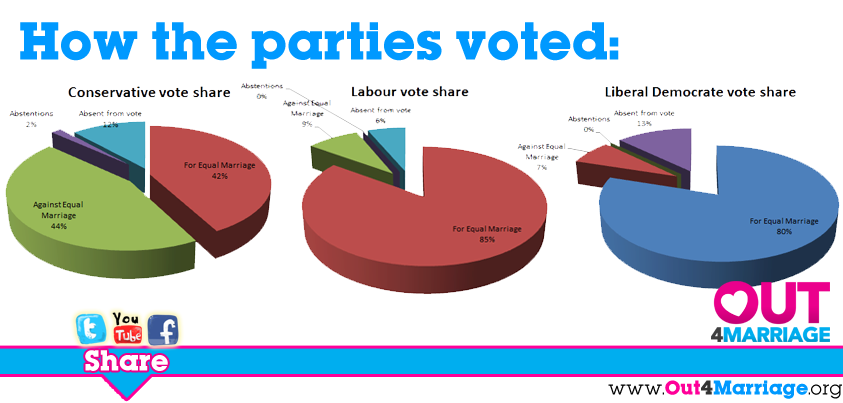
Last night, while wired on a trace of caffeine, I saw an infographic created and shared on Facebook by the Out4Marriage organisation. Views on gay marriage range from Of course, this is the twenty-first century to I’m the MP for Wellingborough, but leaving that issue aside, the graphic disturbed me somewhat. In fact, as a fully paid-up member of the Tufte club, I gurgled something lacking in both grammar and grace.

Here’s the graphic:

out4marriage-pie-original

I shan’t BEGIN RANT here. Suffice it to say that all those pixels have been wasted on twelve numbers, two of which are zero. And you can’t read the labels. And the colours are inconsistent between pie charts. And they’re pie charts. And they’re 3D pie charts. And pie charts with zero-sized slices don’t make any sense. And there’s a typo “Liberal Democrate”. Here’s where I would END RANT, were I ranting, which of course I’m not.

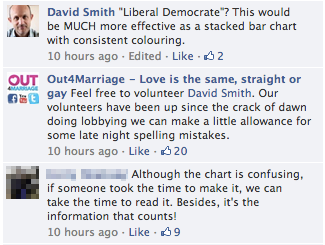
I posted a short comment against the graphic. Here’s a screenshot with the subsequent two responses:

Screenshot_06_02_2013_10_02

What particularly intrigues about Out4Marriage’s response is how it reminds me of the shields up ultra-defensive reply you sometimes receive from developers — especially of open source software — when you have the impertinence to report a bug in their code. The source is there — if you don’t like it, fix it yourself. And it made me wonder whether all voluntary organisations are inherently like that to some extent: deflecting any criticism by inviting you inside the tent to piss out.

Of course, whoever wrote that message also had a point. The people working on the campaign had had a long and tiring day and could be excused a typo, and tedious grammar pedants on the internet are the most tedious tedious grammar pedants since the Microsoft Word paperclip first interrupted us to insist we were writing a letter.

The subsequent comment, though, raised a caffeinated eyebrow. “If someone took the time to make it, we can take the time to read it,” this commenter says. I fundamentally disagree with that statement. It lets the creator of the graphic entirely off the hook. It says, effectively, design doesn’t matter to understanding. It says, effectively, user interface complexity doesn’t matter.

The principle of commensurate effort applies, naturally: you’ll put in the effort if the reward is good enough. You’ll master the incoherent hodgepodge of levers and sticks and buttons and dials and spinny things in a car’s user interface because you receive a huge benefit from doing so.

But an infographic like this has no great reward for deep study. It must communicate its messages simply and coherently and compellingly. Don’t Make Me Think!

For this graphic in particular you want to immediately convey the information that more Tory MPs voted against same-sex marriage than for it; that the other main parties are hugely in favour; and that a significant fraction of MPs failed to make a choice either way, and either abstained (technically, voting both for and against) or didn’t vote at all.

Three 3D pie charts with inconsistent colouring (with red/blue/green colours matching traditional party affiliations but not used as such) and labels too small for most to read even at full size absolutely do not convey that information. The message is lost in chartjunk.

And also: who is this chart for? If I were part of Out4Marriage I’d want a chart that supporters could share on their timelines for non-supporters to see and easily grasp. It’s the non-supporters — the ones who simply will not stop and squint and interpret a complex chart from an organisation they disagree with — you need to design for.

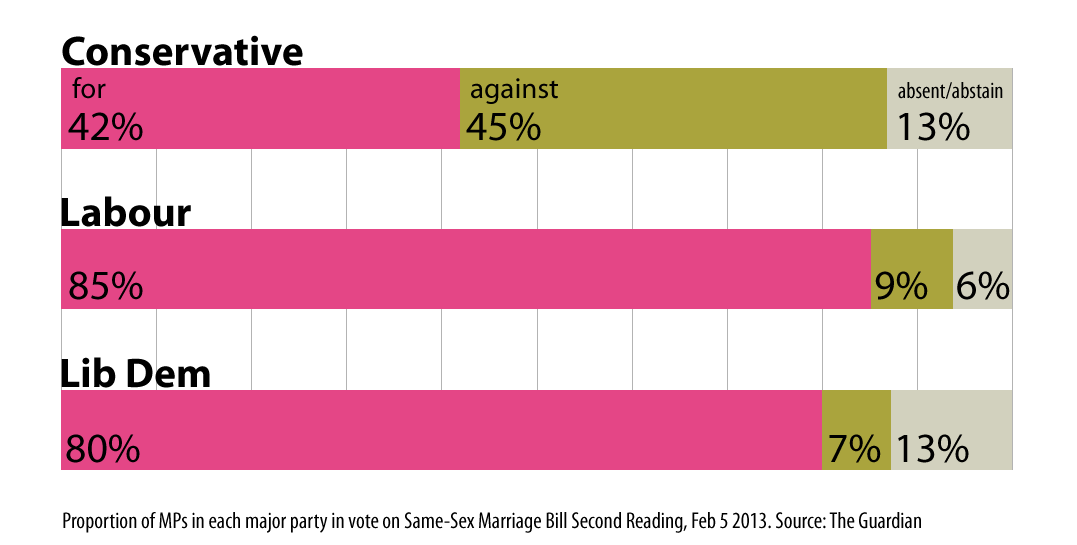
“Feel free to volunteer,” said Out4Marriage in its reply to my comment. So I did. Here’s what I created, minus the headlines and logos that you’d need to add:

ssm-votes

Since only one party included abstainers — the Tories — I combined them with the absentees, and so twelve numbers is reduced to nine. Three stacked bar charts with consistent colours and large labels are easy to see and understand even when shrunk into a Facebook timeline. The ‘for’ colour is taken from the Out4Marriage brand. The ‘against’ colour is contrasting, pretty much, and deliberately sickly. The ‘absent/abstain’ colour is less of a highlight but still prominent. None of the colours are associated with political parties.

Much better, I think.

(While I was creating that chart, Out4Marriage posted a newer chart that used consistent colours and included a clear legend. It still had three 3D pie charts.)

I posted another comment to the original chart, pointing to my timeline for my version and apologising if anyone was offended by my earlier comment. I hope they see it, and take notice.

Everything an organisation publishes under its name sends a message. The opponents of Out4Marriage are well-funded, sending out millions of leaflets designed and worded to convince readers to lobby their MP to vote against equal marriage. You can bet they are now redoubling their efforts, selecting data that favours their cause, even after a 400-175 vote defeat at second reading, and presenting it as if they’re on course to defeat the bill.

Design sends a message. Everyone must know what your message is. Especially you.

4 Comments

Filed under Random

Disunited

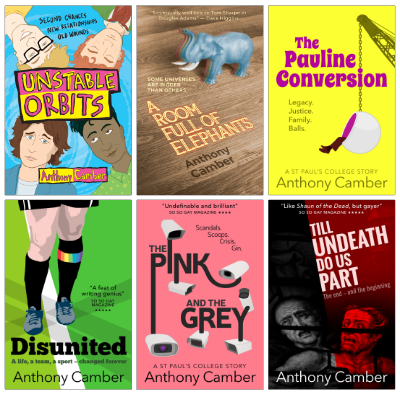
Just a short update to let readers of this blog know that my alter ego Anthony Camber has released his latest novel. Called Disunited, it’s a comedy with added drama about a top young footballer who comes out as gay. Serendipitously it arrives to coincide with LGBT History Month and the Football v Homophobia month of action. Luckily it arrives before an actual footballer has actually come out.

Disunited is available as an ebook for Kindle, Kobo, iPad/iPhone/iPod Touch (and other devices via Lulu) and also in paperback from Amazon.

I remain staggered that I can make the final tweaks to the content on Tuesday and have professionally printed and bound copies in purchasers’ hands by Friday morning. I love living in the future.

Read the publication post on the Anthony Camber blog…

Leave a comment

Filed under Random

Avaragado’s 2013 predictions

2012! Who could forget the glorious summer? The coronation of Queen (formerly Sir Alan) Amidala? Britain’s abject failure in the 1500m tug-of-raw at the organic Spacelympics? The universal acclaim for the politics of austerity?

As the dregs of the year drip from the meths bottle of tomorrow into the tramp’s mouth of history and dribble through the foetid beard of ornithology onto the mangy dog’s head of clinical studies at Guy’s Hospital, it is time to stare resolutely past the tramp’s outstretched palm of invisibility to what 2013 will bring forth, or perhaps fifth. Here’s what I think:

News

  1. The Assad regime in Syria will fall.
  2. There will be no changes in US federal gun-control laws.
  3. The Duchess of Cambridge will give birth to a human boy.
  4. At least one Tory MP will defect to UKIP.
  5. The equal marriage bill for England and Wales will pass in the Commons but not the Lords.
  6. Dangerous idiot Michael Gove will be involved in a scandal over the exam board selection process for the new EBacc exams.

Sport

  1. Manchester United will win the FA Premier League.
  2. Chelsea FC will change manager at least twice.
  3. At least one British person will win a Wimbledon title.
  4. Mo Farah will win at least one gold medal at the World Athletics Championships.
  5. Rory McIlroy will win at least two majors in golf.
  6. At least one footballer playing in the UK will come out as gay or bisexual.

Science and technology

  1. Microsoft will buy Nokia.
  2. Scientists will announce the synthesis of one or more atoms of element 119 or higher.
  3. NASA will declare that Voyager 1 has left the solar system and entered interstellar space.
  4. Scientists will announce the discovery of an ‘Earth twin’ – an Earth-sized exoplanet within the habitable zone of its star.
  5. The year will be one of the ten warmest years in the global record, and warmer than 2012, according to the World Meteorological Organisation.
  6. Archaeologists will confirm that the bones dug up in a Leicester car park are those of Richard III.

Entertainment

  1. Lincoln will receive the Oscar for Best Picture.
  2. Daniel Day-Lewis will receive the Oscar for Best Actor for his performance in Lincoln.
  3. Jennifer Lawrence will receive the Oscar for Best Actress for her performance in Silver Linings Playbook.
  4. The 50th anniversary of Doctor Who will involve appearances (in newly filmed scenes) from at least one former Doctor.
  5. The BBC will cancel The Sky at Night (probably while pretending not to).
  6. The UK entry will finish in the third quarter of the rankings (ie, top half of the bottom half) in the Eurovision Song Contest.

Celebrity Deathwatch

In previous years I’ve named six people. This year I thought I’d round it up to nine, but then discovered three of my names overlapped with Andrew’s (caution: Facebook). Consequently I added three more, to make twelve.

Also, I’m adopting Andrew’s scoring system: each valid death (occurring at any time in the year) scores that person’s age at death subtracted from 100. For example, an 85-year-old’s death would score 15 points, and a 101-year-old’s would score -1 point (thus making it a daft choice). For reference, I’ve included the age of each of my selected celebrities, as at January 1st 2013.

  1. Denis Healey (95)
  2. Nelson Mandela (94)
  3. Mickey Rooney (92)
  4. Nancy Reagan (91)
  5. Richard Attenborough (89)
  6. Robert Mugabe (88)
  7. George H. W. Bush (88)
  8. Richard Briers (78)
  9. Barry Humphries (78)
  10. Shirley MacLaine (78)
  11. Bill Murray (62)
  12. Piers Morgan (47)

Please join me next New Year’s Eve for the official adjudication and other assorted lols.

2 Comments

Filed under Random

Avaragado’s 2012 predictions – results

As usual the cider-enhanced Chris Walsh has cast a rheumy eye over the predictions I made a year ago and awarded the marks as he saw fit. Adjudications and correct answers in square brackets.

News

  1. It will be announced that the Duchess of Cambridge is pregnant. [1pt]
  2. Ed Miliband will be replaced as leader of the Labour party. [0pt]
  3. The US presidential election will be between Barack Obama and Mitt Romney. Obama will be re-elected. [1pt]
  4. At least one country will leave the euro. [0pt]
  5. Boris Johnson will be re-elected as Mayor of London. [1pt]
  6. There will be an earthquake in the UK of magnitude 4.0 or above on the Richter scale. (I’m only using this scale as it’s the one used on the Wikipedia page for UK earthquakes.) [0pt]

[Score: 3/6]

Sport

  1. Great Britain & Northern Ireland will win 21 gold medals at the Summer Olympics, and over 50 medals in total. [1pt: GB&NI won 29 gold and 65 in total]
  2. Great Britain & Northern Ireland will top the medal table at the Paralympics. [0pt: third, after China and Russia]
  3. Spain will win the Euro 2012 football tournament. [1pt]
  4. The United States will regain golf’s Ryder Cup. [0pt: Europe won in a very close finish]
  5. Jensen Button will regain the Formula One championship. [0pt: Sebastian Vettel]
  6. Manchester City will win the English Premier League. [1pt: with a last-minute goal on the last day of the season]

[Score: 3/6]

Science and technology

  1. Having miraculously survived 2011, Steve Ballmer will definitely be fired as Microsoft CEO. [0pt: still there!]
  2. CERN will announce the official discovery of the Higgs boson. [0.999pt, rounded up to 1pt]
  3. Apple will launch a TV. [0pt]
  4. At least one of the co-CEOs of RIM will be fired, and the company will be bought. [0pt: Jim Balsillie resigned but was not fired, and RIM wasn’t bought]
  5. The next version of the iPhone will include an NFC chip. [0pt: rumoured for the 5S]
  6. Amazon will release a free version of the Kindle. [0pt: but Chris wishes they would, as he sat on his and broke it]

[Score: 1/6]

Entertainment

  1. The 2012 season of X Factor in the UK will be the last. [0pt: nothing announced – time will tell!]
  2. In Doctor Who, the replacement for the Ponds will not be from Earth. [0pt: nothing to suggest she’s not from earth – time will tell!]
  3. Best Actress Oscar: Meryl Streep for The Iron Lady. [1pt]
  4. Best Actor Oscar: Jean Dujardin, The Artist. [1pt]
  5. Best Picture Oscar: The Artist. [1pt]
  6. CNN will fire Piers Morgan. [0pt: although competing petitions to deport/refuse repatriation suggest nobody wants him]

[Score: 3/6]

Celebrity Deathwatch

  1. Former anthropology student, US evangelist Billy Graham. [alive!]
  2. Former ophthalmology student, Syrian president Bashar al-Assad. [alive!]
  3. Former chemistry student, Baroness Thatcher. [alive!]
  4. Former naval cadet, Prince Philip. [alive!]
  5. Former Cassius Clay, Muhammad Ali. [alive!]
  6. Former Hitler Youth, Pope Benedict XVI. [alive!]

[Score: 0/6]

[Total score: 10/30]

Not as good as last year. I suspect I was a year early on most of the science and technology predictions. And my celebrity deathwatch category maintains its staggering 100% failure record.

Stay tuned for Avaragado’s 2013 predictions…

2 Comments

Filed under Random

A government in three acts

The three-act structure is a staple of the movie business. Look behind most popular movies and this structure reveals itself: beginning, middle, end. Or setup, confrontation, resolution.

In act one, we meet the protagonist and other major characters and the nature of the plot is revealed to us. The end of act one sets the story moving properly. Think Elliott meeting ET, or Dorothy landing in Oz.

Act two is about confrontation. The protagonist experiences setbacks and danger. The stakes rise. Things are tried, which fail. But there is forward motion: ET builds his machine from a Speak’n’Spell and starts to form a psychic link to Elliott. Dorothy meets new tin, fur and straw-based companions and skips towards the Emerald City and the wizard.

At the end of act two all seems lost. ET is captured and dies. The wizard turns out to be a man behind a curtain. And here, as at the end of act one, the story turns again. ET is resurrected. There is a way for Dorothy to get home.

Act three takes us from there to the final fade to black. ET escapes with Elliott and his mates, and is picked up by those who left him behind. Dorothy clicks her heels together and repeats “there’s no place like home” and wakes up in black-and-white Kansas.

It’s not just movies that have three acts of one form or another. Books often do. Lives do. Blog posts like this do (welcome to the end of act one). And so do governments.

The current government’s first act ended at about the time Nick Clegg abandoned the pledge not to raise tuition fees. Regardless of the merits or not of the final legislation, the story changed at that point. The honeymoon was over, if you like, and the mid-term blues set in: the act two confrontations of unpopular austerity policies, of riots, and disruption.

I haven’t mentioned one aspect of the theoretical second act: you’ll often find another pivoting point somewhere in the middle of the film, where something happens to raise the stakes or change the game. This helps to avoid the all-too-common second-act lull (second acts tend to be the longest). In ET, the midpoint is where we realise that ET and Elliott are linked — that wonderful sequence cutting between a schoolroom frog dissection and ET watching TV with a beer or two.

We’ve reached the midpoint of the government’s three acts about now. We’re about half-way through the five-year term, there’s just been a cabinet reshuffle, and we’ve had the massive mood-changers of the Olympics and Paralympics.

How these affect the story remains to be seen. It’s especially hard to judge whether London 2012 — in all its aspects — will have a lasting effect. As someone who attended both the Olympics and Paralympics as a spectator, I can only say that I came away with a huge sense of pride at all the achievements — in organisation, in delivery, in service, in sport. We can do better than we think. We have done better.

Do we want to return to the old ways?  To the petty bunfights and playground games of parliament? Will the rest of the second act of this government squander this midpoint twist with the reshuffle’s apparent lurch to the right? And then more cuts: slicing away the remaining safety nets, selling off chunks of the NHS, condemning another generation of schoolchildren to endless educational dogmatic tinkering.

Sadly, this seems inevitable.

But at some point, act three arrives. Something happens to allow the escape to the UFO, or the return to Kansas. The beauty of the three-act structure is that the acts can be as long or as short as they need to be. The “midpoint” needn’t be dead-centre. The act two twist can be right before the end of the movie.

So when does Nick Clegg return to Brussels?

Leave a comment

Filed under Random

Embracing the obsessives

Broadly, a subject has three types of audience: uninterested, interested, and obsessive. There are probably nuances here and Gartner would undoubtedly conjure up a four-quadrant chart and charge you several grand for it, but humans like things in threes so that’s where I’m going.

Each of us occupies one of these roles for a subject (the role might change over time). I count hate as interested: you have an opinion. I’m uninterested in Eastenders; I’m interested in X Factor (I want to kill it with fire); I’m obsessed with the Olympics.

Where this gets interesting is how these partitions are considered by content producers.

In almost all cases, newspapers and TV news programmes aim at the interested, ignoring obsessives and uninteresteds.

Consider TV news coverage of football. It assumes you follow the game — it never explains offside, or the league format (unless it changes), so it’s not for the uninterested. It doesn’t have three people arguing over the merits of a free kick, so it’s not obsessive either.

It’s similar with economics: if you don’t understand what GDP actually means (as opposed to the acronym’s expansion), you’re out of luck. But I bet economists regularly scream “it’s not as simple as that!” at the screen. The uninterested and the obsessive aren’t the targets.

The exceptions in news programming seem to be with science and to a lesser extent technology. With coverage of space exploration and physics, the target seems to be the uninterested almost exclusively. Mars is described as the fourth rock from the sun, cold, etc, almost every time, and Higgs is “the so-called God particle”.

Imagine if BBC News said: “Today in the Premier League, which is the richest and most important football league in England, the Liverpool FC club, which plays at a large stadium called Anfield…”

Producers might argue their coverage is as deep as the audience’s knowledge, and the audience knows more about football than about Mars. True, up to a point: but I think the audience knows far less about economics (and politics) than correspondents assume.

With science, it seems the interested and obsessive audiences are deliberately left adrift. The recent coverage of Neil Armstrong’s death was mostly lightweight, and the BBC’s online obituary leads with this excruciating paragraph:

In 1969, Neil Armstrong became the first man to walk on the Moon and arguably the most famous man in the Universe.

As Wikipedia would say: citation needed.

Even a specialist, nominally interested-aimed show like Horizon often fails: there’s too much enforced drama, and the target appears to be someone who progressed only recently from uninterested. I can’t help but think this reflects the status of the production team.

The obsessive science audience is today not considered at all on TV, with the possible exception of The Sky At Night. I think this is very much down to its longevity and to Patrick Moore, and I wouldn’t be surprised if, once he leaves us, the show is quietly shelved as “coming to a natural end”.

Earlier in the year Professor Brian Cox gave a televised lecture on quantum theory. At last, I thought: targeting the high-end interested and the obsessive. And yet, amidst the actual science, there had to be celebrity involvement — Jonathan Ross doing maths, etc. I can picture the production meetings, where confused barely interested TV bods desperately tried to drag the target towards them.

A journalist I follow on Twitter was nevertheless confused by the lack of footage of Cox silhouetted by sunsets and wondered in a tweet whether he had now jumped the shark. I gave her the 140-character version of this post. She didn’t reply.

Irritatingly TV can cater for obsessives. The Big Brother auxiliary shows (such as Big Brother’s Little Brother and its Desmondesque successor on Channel 5) and similar spin-offs are targeted at hard-core fans. And for this year’s Olympics the BBC provided, for no additional cost, up to twenty-four channels of uninterrupted sport. If you wanted fencing prelims, you could watch them (and you still can, until January). BBC1 and BBC3 dipped around, catering for the interested with blanket coverage. (The uninterested had the even-numbered channels.)

The medium that has embraced the obsessives like no other is the internet, of course. (There are obsessive magazines too, like Maximum Carp and Carpology and so on, but the net out-obsesses these comfortably.)

Which brings me back to to Mars.

The seven minutes of terror before Curiosity’s touchdown were just before 6.30am UK time. The interested might’ve watched BBC News in the hope of some coverage. I’m an obsessive and watched NASA TV online, which showed the action from the control room live. Even this, annoyingly, cut away later to clumsy interviews, when all I wanted to do was listen to the mission control loop. (That was available on the net, Roger told me later. He’s a hardcore obsessive.)

But NASA’s usually great at cultivating obsessives. I can watch and listen in to Curiosity briefings and teleconferences live, uninterrupted by a journalist talking over the science. The Curiosity team also took part in a Reddit AMA that produced a bunch of intelligent, occasionally high-end obsessive questions.

Does it matter that mainstream TV doesn’t cater for science obsessives? I don’t know. I’d like to think it matters. The BBC argues that BBC1 and BBC2 have a general remit, and then dedicates sixteen days of BBC1 6am-1am to sport for the Olympics. Is it too much to ask for an hour of proper, obsessive science a week? A month?

But then, I’d probably have read it on the internet already.

4 Comments

Filed under Random

Examinations for Dummies

At today’s Prime Minister’s Questions, in response to a question about the government’s apparent plan to replace GCSEs with something like the old O Levels and CSEs, David Cameron said: “On this side of the house we think we need a rigorous system and that’s what we’re going to put in place.” And who could disagree with that?

He also, naturally, took potshots at Labour: “The tragedy is that what we inherited from the last government was a system that was being progressively dumbed down, where Britain was falling down the league tables, and GCSE questions included things like ‘How do you see the moon, is it through a telescope or a microscope?’” (Source: video on the BBC Democracy Live web site, from about 26:06, transcribed by me. I have no idea how persistent that URL will be, but Hansard will have an approximation to that text tomorrow.)

His mocking of the moon question revealed a deep ignorance of the examination system. His Education Secretary, the dangerous idiot Gove, presumably has similarly ignorant views.

What, I wonder, would they expect to see in an exam? A series of questions of equal and maximal difficulty? Presumably the correct answers to all questions would give you an A grade and thus the stamp of Tory approval, with the other grades distributed across those students who answered only some of the questions correctly. There. Easy.

But what have you learned?

You’ve learned that not all students can answer hard questions. Well, that’s not a great surprise. And in fact, for a maths or science exam with absolute right/wrong answers I’d imagine you’ve learned, to a first approximation, that a tiny number of students answer most or all questions correctly, because they’re the brightest in the class, and the rest get very few marks at all.

The reality is, you’ve learned nothing about the less able students or the mid-range students at all. You certainly haven’t learned how able anyone is. You’ve just partitioned the students between “can answer hard exam questions” and “can’t answer hard exam questions”.

This is demonstrated easily by pub quizzes. The worst quizzes consist of equally tough — or equally easy — questions. Either way you sit with your pint of orange and lemonade in grinding frustration, either writing Trotsky against every question or scribbling in the answer before the question’s finished. These quizzes frustrate the participants and serve only to make the question master look foolish.

Here’s what exams should do, which is — not coincidentally — what exams actually do.

Exams should include easy questions so students at the low-ability end of the scale can score more than zero. If you don’t do this you alienate them. You brand them as useless, as utter failures. They feel excluded and worthless. This is not good.

Exams should include questions of increasing difficulty, so you can more easily differentiate abilities. “What is a lunar eclipse?” “Give an example of a way to view the sun safely.” “Draw on the diagram the main components of a reflecting telescope.” (I have no idea whether these are real questions, or whether they’d be considered acceptable questions. They’re off the top of my head and seem to me to be in increasing difficulty. But I don’t set exams.)

And of course you need to stretch and challenge the most able students. “Give one reason why we shouldn’t fire Gove into the blazing heart of the Sun.”

GCSE: General Certificate of Secondary Education. GCE: General Certificate of Education. Exams allow students of all abilities to demonstrate their knowledge and to receive appropriate credit. They do not exist to serve only the most able students: they must be accessible to all.

Just about anyone with any knowledge of the education system could tell the Prime Minister this. The Education Secretary should be well aware already.

If they both do understand this point, then what are they really trying to do to the education system?

But if not: grade F.

5 Comments

Filed under Random

Remembering Alan Turing

After the Great Fire of 1666, Sir Christopher Wren rebuilt St Paul’s Cathedral and much of London. Three centuries later St Paul’s still stands, still dominates the skyline, despite the needles and vegetables and distended pyramids that have grown up since.

The Tower of London, St Paul’s Cathedral, the Palace of Westminster, Tower Bridge, the London Eye, the Gherkin, and now the Shard. Familiar shapes, instantly recognisable silhouettes. Over nine hundred years of architectural history.

In 1676 Sir Isaac Newton wrote to Robert Hooke: “If I have seen further it is by standing on the shoulders of giants”. As in architecture, as in science. The tower of knowledge grows ever faster.

We are surrounded by computing power orders of magnitude greater than took man to the moon, which was itself orders of magnitude greater than helped break Enigma and Lorenz/Tunny.

In seventy years the computing skyline has leapt up: the buildings ever taller, ever shinier, and topped with ever louder bells and ever shriller whistles.

But the work of Alan Turing still dominates. A century after his birth, and almost sixty years after his death, his achievements are still discussed and lauded. Turing is the Wren, the Newton, of computing.

Wren lived to 90. Newton lived to 84.

Turing lived to 41.

He died, ultimately, at the hands of a state he helped preserve.

What might Turing have achieved had he lived as long as Wren, to 2002? How might the world be different today?

How might the world be different had he taken his life before the war?

There are petitions online urging the government to pardon Turing, and to put him on the tenner. Both worthy, both insufficient.

We should remember Alan Turing through education. To ensure that we can produce more like him, who can stand on his shoulders and make new breakthroughs in maths, in computing, and in other sciences. And to remind people that bigotry and inequality, whether by person or by church or by law, have no place in society.

In St Paul’s Cathedral, inscribed in a ring of black marble beneath the dome, are the words “LECTOR SI MONUMENTUM REQUIRIS CIRCUMSPICE”. An epitaph to Sir Christopher Wren — and quite apt for Turing too, I think.

Reader, if you seek his monument, look around you.

2 Comments

Filed under Random