On loan from the future

My previous blog post lit up the zxdar of one of the good citizens of World of Spectrum, Gerard Sweeney. A flurry of emails later and The School now has its own entry in their database, as do your humble author (hello!) and the game’s co-creator Dave O’Neill. Gerard kindly produced a less bulky TZX file, as mine was apparently just a sample dressed up with a bow and pigtails. You can now download this version from the game’s page on World of Spectrum. Achievement, as the kids say, unlocked.

I’m also told that my Spectrum, serial number 001-000046, is very possibly the earliest still known to exist.

The 46th ZX Spectrum

S Mind blown, 0:1

I mean, I’ve always believed at most 45 machines could have tumbled off the production line before mine — that much makes sense. But I’d never given a deal of thought to the notion that all 45 might have become landfill or otherwise returned to component form. I assumed that 001-000001 would be under glass in Sir Clive’s penthouse suite, which as we know is made from the dismembered carcasses of old C5s and decorated with photos of Chris Curry pricked by infinite darts.

But if mine is the earliest, then I now have one of those pesky responsibilities.

I can’t pretend I don’t feel a manly breeze of vindication about this, in fact almost chest-thrustingly self-righteous and proud. Like those at World of Spectrum I am passionate about the preservation of our computing heritage, and our technological heritage in general. Too often these things are seen as ephemeral, as mere fashion. DC-powered shoulder pads. Here today, gone tomorrow, like not enough politicians. But this is why early comics like Superman #1 or Batman #1 or of course Captain Britain #10 are so rare, and so valuable. Why should technology be any different?

It’s one of the reasons I still have, I think, somewhere, I hope, almost all the tech the family bought in the seventies and eighties. I wish I’d been able to keep all the magazines too — but when my parents downsized a decade or so ago I bade many piles a tearful farewell (I couldn’t store them all at mine). Sadly I think they were all recycled. I did keep those issues I considered interesting or important or milestones: I should hunt them down to see if they’re rare yet. I suspect not.

Organisations like the BBC and NASA have a similar but different responsibility to preserve material: our culture, and our discoveries. The constant churn of storage formats and file formats means you can’t just store tapes: you need to store and maintain the players too, and code that can read the files, or have a rolling upgrade programme with all the comedy potential for error and loss. We can’t assume that future generations will reverse engineer everything we leave them, should the data even physically cling on to whichever media it was entrusted to. It’s a sad truth that the most durable form of much of today’s data is still (the right sort of) ink on (the right sort of) paper.

Forty years of removable storage

There’s a fascinating series of videos from the BBC’s R&D team about the challenges they face with archives. Some newer storage formats are less easily read than old film, such has been the pace of technological progress.

Occasionally this need to preserve — or desire to make public — old data brings surprise benefits. Touching the originals means you can process them in ways not perhaps feasible when originally produced. For example, the American researcher Don Mitchell was able to access original Soviet space mission records from the 1970s — and produce amazing new/old images from the surface of Venus.

But if you don’t have the original tape (or disk, or…) or you don’t have a working reader, or (to a lesser extent) the file format is unknown, you’re stuffed. The data is gone. See also: backups.

The technology industry is now old enough to need historians. In truth it has been for a long, long while. It’s nothing short of scandalous, in hindsight, that neither Colossus nor the Bombes — and not even their designs — were preserved for history after World War II, as far as we know. (I wouldn’t be surprised if GCHQ holds more than it publicly admits — it did recently release an unknown paper by Alan Turing.)

Thankfully, organisations like Bletchley Park and the Computer History Museum now recognise the importance of this issue. World of Spectrum realises it. NASA and the BBC are spending fortunes to stand still, because of it.

Maybe I should write an ebook about it.

3 Comments

Filed under Random

ZX Spectrum+30

On Friday 23 April 1982, the Royal Navy task force was steaming south towards the Falklands. At the same time, advance forces were preparing in secret to retake South Georgia, a success which would catapult Margaret Thatcher onto the steps of Downing Street all bug-eyed, bouncing off journalists and imploring us hysterically to “Rejoice”.

Meanwhile at a hotel in London the as-yet unknighted gingerboff Clive Sinclair was unveiling the computer that would replace the year-old ZX81 and its wobbly RAM pack. Everybody had been expecting the launch. Speculation about the ZX81’s successor had been appearing in computer magazines for months. Many people expected it to be called the ZX82.

It was, of course, the ZX Spectrum. With high-resolution 256 x 192 pixel, 15-colour graphics, 16K or 48K RAM and a 3.5MHz Z80A processor, it was a substantial step up from its predecessor. A bit more expensive too: £125 for 16K and £175 for 48K.

I found out about the launch the following day, as on that Saturday my Dad took me to London’s glittering Earl’s Court for the Computer Fair. It was the second computer show I’d been to — the first being the previous year’s Personal Computer World show at London’s guttering Novotel in Hammersmith.

Earl’s Court was packed with nerds and protonerds gawping over the likes of the Vic 20 and the TRS-80. The crowds were especially thick around the Acorn stand — at least partially thronged with people who’d ordered and paid for a BBC Micro (launched a few months before) politely enquiring when the hell it would arrive. In those primitive times we were told to “allow 28 days for delivery” of new computers and were lucky if they arrived in less than a hundred.

I remember seeing the Sinclair Research stand. It was immediately obvious there’d been an announcement: one wall of the stand was plastered with a blown-up image of the new machine. Crowds stood several deep, grabbing leaflets and hoping for a glimpse of hardware. When I pushed to the front I could see a portable TV looping through a demo showing off the Spectrum’s capabilities. If memory serves there were no finished units on display: merely a couple of shrines behind glass, untouchable and perhaps with the paint still drying to hide the wood grain.

Naturally it wasn’t possible to hand over your Thatcherite tenners and take a Spectrum home with you — the demo was, I suspect, all breadboards and pixie dust — but staff would be more than happy to take your order, and your cash.

I salivated. A negotiation began with Dad. Neither of us remembers now how much I paid (or promised to pay) and how much was counted as a belated birthday present, but the result was a scribbled receipt — I believe numbered 1151, it’s in the collection somewhere — and the fizzing anticipation of a delivery of a 16K Spectrum in less than 28 days!

I took away with me one of the brochures, the front cover of which was a life-sized picture of the keyboard. Identical brochures fell out of every computer magazine for the next few months. One travelled in my school bag every day, because if you’re going to obsess on something there’s no point doing it by halves.

Twenty-eight days later the Spectrum had not arrived, of course; but the Royal Navy task force had reached its destination, and the news was dominated with the latest from the Falklands War. It wasn’t until sometime in late June, I think, that I scurried home from school to find, finally, a small brown parcel waiting for me. By this time the Argentine forces had surrendered and the war was over.

Sadly there is no unboxing video, as I had left my iPhone in the future. I unpacked everything solemnly, like a reverse Pharaonic burial rite. I plugged in the power (reviewer criticisms included: “still no on/off switch”) and tuned it in to the living room TV. Finally the message “© 1982 Sinclair Research Ltd” stared back at me with a faint shimmer, and I understood what was meant by dot crawl.

Then one by one I loaded the demo games and tools from the supplied Horizons tape, and heard for the first time the soundtrack of the next five years: brrrrrrrrrrbip! brrrrrrrrrrbipplybeebipplybeebipplybeebipplybeeetc!

And I proceeded, as a true geek, to inhale the manual.

I loved that machine. I came to know every part of it. It suffered at my hands. I upgraded it to 48K. I progressed from BASIC to Z80 assembler — like all real programmers, first by hand-assembling to machine code using the table at the back of the manual. I bought a copy of the Complete Spectrum ROM Disassembly — the Spectrum’s OS decoded and annotated, every byte of it, every bug and whistle. I bought an Interface 1 and ZX Microdrive — each cartridge (a squiggly loop of magnetic tape in a small case) able to hold a massive 85K or so, and loading and saving much faster than cassette tape. I learned how to disassemble and hack games, like Manic Miner and Jet Set Willy and Fairlight and Atic Atac and Knight Lore and and and… and I wrote my own. I hacked and coded for money. I was published in Your Spectrum magazine.

My ZX Spectrum

I loved that machine.

I still have it, of course. My ZX Spectrum is an issue one design: light grey keys, with a hand-patched board inside to fix a hardware bug. This makes it one of the first 60,000 manufactured, I believe.

Serial number: 001-000046. That’s pretty early.

I haven’t powered it up for at least twenty years, and I daren’t do so now in case something goes pop. But I’ve taken some photos of it and every piece of software and every book I still have and uploaded them all to Flickr, because if you’re going to obsess on something there’s no point doing it by halves.

In amongst all the tapes, I was very pleased to find my master copy of The School — the text adventure game I wrote (designed with Dave O’Neill, school friend and one of the commenters on my previous blog post). Although I submitted it to several software houses nobody took it on: the game was never professionally released (it wasn’t good enough) and hasn’t been played since the mid-eighties.

But, you know, we’re living in the future now. You can get ZX Spectrum emulators for just about every platform…

All I needed to do to play it was sample the tape, and load it into the emulator. How hard could it be? The standard Spectrum saving routine encoded data on tape at 1500 baud — roughly 1500 bps. Easy to sample. Ten minutes tops, surely: five to play the tape, five to faff.

Now then. Find your nearest ZX greybeard. If that’s me: hello! Ask him (it’ll be a him) what caused the most problems with Spectrum games. He’ll say gloomily: “R Tape loading error” (the R is an error code). You had to play goldilocks with the volume and treble and bass on your cassette player, hunting for the sweet spot that tickled the Spectrum’s distinctive stripy borders. And also, cassette players tended to wind the tape at different speeds, often speeding up and slowing down. With yer Slade and yer Boney M and yer Wham (note: I owned none of these) it made no difference, but with the intolerant and pernickety Spectrum loading code, it sometimes did.

I proceeded to spend hours (spread over several days) sampling the tape, and loading it into the emulator, and watching it fail. Sometimes it would load one of the three chunks of code, sometimes two, but it never reached the third, the longest chunk. R Tape loading error. The bits were corrupt.

I found a different tape player — in fact, one I used for saving and loading software around the time the Marines were yomping over the Falklands. Sampling with this player didn’t work either.

I even splashed out on a new tape player — one with a USB cable, for sampling directly into Audacity on the Mac. Aha! Better! For the first time since 1984, I reached the third chunk of code and saw the loading screen — and here it is:

I was fifteen, OK? There was no such thing as Photoshop. I hadn’t even built my mouse yet.

Anyway, I thought: since it got that far, why didn’t it load the entire thing? I listened closely to all five minutes of the sample (the third chunk loads 49,152 bytes, from start to end of RAM). And I was surprised to hear, in a couple of places, the sound dip. What? It wasn’t doing that before.

The Falklands-era tape player had corrupted the Falklands-era tape.

Thatcher. It’s always Thatcher’s fault.

In Audacity I zoomed into the waveform where the sound dipped: flatline. Unrecoverable, by me at least. At this point, I emitted some kind of meeping noise and tweeted about throwing something and then myself out of a window.

But then I thought: I still have those earlier samples that didn’t work, sitting in the trash. I went right back to the very earliest and reimported it into Audacity. There was no dip. Then I realised I’d exported this sample first time as a stereo WAV not a mono WAV — and stereo was bad. I exported the right channel as a mono WAV, and tried that.

It worked. The game loaded.

I immediately tweeted: “Um, OK. Um. Blimey. Well. This is. Cor. Now then. Burble. *makes backup, cup of tea, squealing noise*”. It received a few worried responses. I just stared at the emulator screen.

As I write these words, I haven’t yet tried to play the game. Somewhere in my parents’ house is a complete walk-through for reviewers, sent with the tape to the software houses. Right now I can remember only one puzzle: the first one. It involves a hammer cage.

Would you, by any chance, like to play it? Here it is: the-school.tzx (apologies for Google Docs link). [Edit 2012-06-06: now available from World of Spectrum] Open it in the emulator of your choice (I’m using Fuse for Mac OS X). Press zero to delete (I’m sorry – on the Spectrum, delete was Caps Shift-zero, and for some reason I decided to “make it easier”). When a flashing block appears at the bottom right, press Return.

I warn you: it’s not particularly logical. It doesn’t have a sophisticated parser. It’s slow. I have no idea whether it’s entirely uncorrupted: it might be unsolvable. If you were at Sheredes School in the early 1980s you might know your way vaguely around. Of course, any character’s resemblance to any actual teacher or pupil of that period is entirely coincidental.

ZX Spectrum: thirty years old today. For The School, well, you just had to allow 28 years for delivery.

PS Possibly of interest: Rick Dickinson’s original industrial design sketches for the ZX Spectrum, and more.

20 Comments

Filed under Random

The generation gap

As we slobber before our mega-tellies laughing at gypsies or braying neon quiz shows it sometimes escapes us that we’re totes living in teh futur. We regularly eat space pills, for instance, and clamber aboard our personal UFOs for weekend breaks at Moonbase Alpha. Anti-gravity holes in the floor, the ubiquitous uppy-downies, have long replaced the jagged slashes of carpentry our comically primitive ancestors subjected themselves to for trivial vertical translation. And I don’t know about you, but I couldn’t live without my nuclear fusion podule. I keep mine in the cupboard under the— er, the cupboard beside the uppy-downy, with the spare robot parts and the Yahtzee.

Well, maybe we’re not quite there yet. But we have smartphones and the internet, and the instantaneous global communication of 140-character inanity that would’ve looked miraculous to my beflared, jazz-patterned, unbald seventies self.

Like many of a certain age, this cheeky mewling scamp annually devoured the Norris McWhirter non-fascist factorama that was the Guinness Book of Records. It was a more innocent time, a time before spurious non-record records (“most critically acclaimed seventh-generation puzzle game”), a time before full-colour illustrations, a time before graphic design. Simply column upon column of facts, cold hard facts, longest serving this and first that, perhaps accompanied by a blurry half-tone image of Roger Bannister wheezing.

I was fascinated by the simpler human records like tallest man and in particular oldest living man (I was — please prepare yourself — uninterested in the women). At that time the record-holder was a Japanese man, Shigechiyo Izumi — since expunged from the book after it was realised he’d never been seen in the same room as Clive Dunn. According to the Guinness World Records web site the current holder of the record for oldest (not living) man is Christian Mortensen, who died aged 115. Though since the relevant page claimed for some time that he was born in 1825 rather than 1882, I suspect their fact checking has gone to cock since McWhirter relocated to right-wing stats heaven.

While Izumi was still being worshipped as lord of the undead my young mind boggled that someone (allegedly) born in 1865, before even the invention of the trimphone, might still be alive at that time. The oldest living person today, in our velour spacesuit future, was born in 1896 — and there are only twenty-six people verified as born before 1900 and still going (just one of them, the youngest, British). These numbers will, alas, soon dwindle: seven have died so far this year. Within a few short years there will be nobody alive who can claim to have twice endured the tedious arguments about which year begins a century. But there are certainly some now living who will be able to make that claim, in another 88 years or so. A mere geological and by then gerontological trifle.

There should, I contend, be a hands across the centuries event while such a thing is possible. Richard Branson or David Cameron or another PR luminary should bus and stairlift in everyone born before 1900 to a great gathering at Greenwich, on the meridian, whether they want to or not, and have them mingle with confused young children and photographers. They could shoehorn it into the Olympics somehow, and have Boris Johnson or his earthly representative fly in on a sponsored zip wire. Somewhere in the mix will be a child who will see the first nano-fireworks of the twenty-second century fly and spin and footle disappointingly, from their hoverchair in an Old Folks’ Home on Ganymede, and whose weary space fingers could gesture up the holoimage of them being thrust into the face of a refugee from the nineteenth century. What a moment that would be. A dull moment, true, but a moment.

I’m sure, although the execrable Guinness web site refuses to allow me to locate it, there used to be a record along the lines of “last parental link to the eighteenth century”. Luckily the internet and the wonderful @lettersofnote Twitter feed tell me the answer: the father of Alice Grigg (1863-1970) of Kent was born to a small collection of powdered wigs in 1799. A total of 171 eventful years between the start of one generation and the end of the next.

However, and still bogglingly, there are extant grandparental links to those times. Indeed of all people the tenth president of them there United States, the lowly regarded John Tyler, who was born in 1790, has two living grandchildren. Three generations spanning almost the entire history of the country, from beginning to end (do you see what I did there?).

Compare that to today in Cameron’s Britain, where people are having grandchildren almost before puberty. January’s newborn is December’s four-greats. Generations are flashing past more quickly than Andrew Lansley at a heckling competition.

In my day you didn’t have children, you had 16K and were happy with a Jet Set Willy knock-off. Still am, come to that.

10 Comments

Filed under Random

The Gove-Santorum axis of immorality

Michael Gove is the antichrist, isn’t he? Surely? Or is it Rick Santorum? It’s got to be one of them. Maybe it’s both? Maybe they’re two halves of the antichrist, two snap-together segments. The Lego antichrist. And in the nightmare scenario, the antichrist-enabler Cameron is toppled by Gove’s satanic helpers (prop. R. Murdoch) — who then install their dark lord as PM and scoot across to the US to engage in a holy fiddle to rig the election for Santorum.

Then at their first meeting, the first Gove-Santorum swivel-in, the two shake damp hands and a spark and a purple flash herald the apocalypse. Jagged cracks bubble with lava, flying monkeys with little matching purple hats flock and swoop and snatch up children and animals, and the Daily Express worries about the effect on house prices, blames the BBC, and pins its hopes on a large photograph of Princess Diana.

I mean, how is it conceivable in the modern world, with all its facts and actual knowledge and stuff, that these two dangerous idiots aren’t simply guffawed off the stage?

It is said that a mere touch from the former Senator from Pennsylvania audibly and visibly leeches the intelligence from your bones; and that cameras watching him pass through a crowd are steered away to avoid spotting the desiccated husks crumbling into neat piles of dust in his wake.

And Gove, poor Gove, his grey face never far from confused over-tired tears, is busily thrusting Britain’s education system forward into the 1950s, ensuring institutionalised faith-based homophobia, and sucking up to his once and future boss Murdoch like the Tories of Thatcher.

I despair.

You know, I thought you were supposed to get more conservative as you age: shifting from denim to the elasticated waistbands of M&S and all the comforts of traditional bigotry such as the Daily Mail. Instead I find I’m becoming more militant: I am intolerant of intolerance, of ignorance, of idiocy, of demagoguery. I might be a Grumpy Not-So-Old Man. Or, more likely, one of those militant homosexual atheists everyone is allegedly so afraid of. I fear I am in grave danger of buying a pair of co-op hemp dungarees and selling Socialist Worker on street corners, and muttering fascist under my breath at anyone with a newer iPhone than me.

The irony, I suppose, is that what jiggles my frosting about Gove and Santorum and, in fact, most politicians, is their sheer immorality.

Gove, supposedly working for us as Education Secretary, but meeting every five minutes with Murdoch — who, coincidentally, wants to make lots of money out of education. And good lord: the first “free school” to sign a funding agreement with Gove was co-founded by Toby Young, who is now a political columnist with Murdoch’s Sun on Sunday and whose first column tipped Gove as a future prime minister.

Santorum, misty-eyed wobbly-lipped defender of the Constitution of the United States of God Bless America, who says “I don’t believe in an America where the separation of church and state are absolute” and that such a separation was “not the founders’ vision”. OK, let’s hear from Thomas Jefferson, actual founding father and actual principal author of the actual Declaration of Independence. On New Year’s Day 1802, when he was actual US President, he wrote: “I contemplate with sovereign reverence that act of the whole American people which declared that their legislature should ‘make no law respecting an establishment of religion, or prohibiting the free exercise thereof,’ thus building a wall of separation between church and State.”

Immorality.

Like giving your corporate chums free labour and calling it voluntary work experience while threatening to withhold benefits from the slaves if they don’t comply. That’s immorality.

Like insisting that your right to marry is determined not by your character or your devotion or your behaviour, but by your chromosomes. That’s immorality.

There surely comes a time at which the immorality of those in and around power — which includes politicians, the journalists that cravenly support them, and the corrupt police — finally turns upon itself. This immoral triangle of power, rusting and crumbling. That day might be closer than we think.

And now if you’ll excuse me, I’m off to buy some dungarees and possibly a small cave in the Lake District.

4 Comments

Filed under Random

Tumbleweeds and plugs

I apologise, dearest reader, for the tumbleweeds bouncing through this blog in recent weeks. I have been neglecting you in favour of another: pouring my frothing muse into longer works of fiction. I’m pleased to say the first of these has now set and been whittled into editorial shape via the passage of time, a drawer, and some helpful feedback.

I’m not writing as David Smith since that returns more hits on Google than there are atoms in the universe. To be read you first have to be found, and my real name is — unless you are very determined — a near-synonym for anonymous. Not Anonymous, just anonymous.

Nor am I writing as Avaragado, as people can’t say it (av-uh-ruh-GAH-doe) or spell it (tip: it’s all a’s apart from the o) and I’d need to make up a first name or last name to jigsaw onto it or else spend precious nerd energy fighting Facebook and Google+ naming policies.

After much deliberation I settled on Anthony Camber. “Anthony” is my middle name and my Dad’s name; and “Camber” is, as many of you know, a place on the south coast that holds fond memories for me, and which I’ve been visiting on and off all my life. And, excitingly, I could get anthonycamber.com and @anthonycamber, and there’s nobody else with that name on Amazon, and there doesn’t appear to be an under-23 Welsh rugby player with that name, and so on.

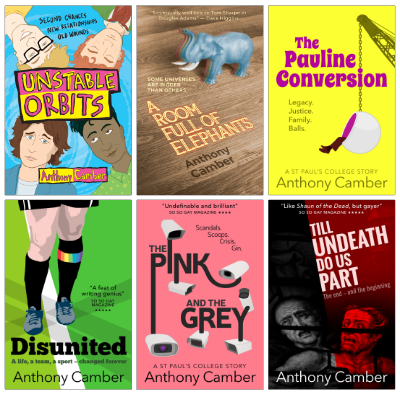
The first story I’m publishing is a novella, running at just under 25,000 words. If you haven’t already zipped over to anthonycamber.com it’s called Till Undeath Do Us Part, and it’s about zombies in Cambridge (with a side-order of gay). As much as I’d like to claim the label it’s not exactly a HomZomRomCom, but there are elements of all four oms. It is apparently “A right rollicking read” and “Highly recommended” (Mr C Walsh, Cheque-in-the-Post, Cottenham).

It’s available now on Kindle. You can, and indeed you must, start reading in under a minute. iPad/iPhone/iPod Touch owners will have to wait up to a couple of weeks for it to emerge glittering from Apple’s mysterious approval process into the iBookstore, or use the Kindle reader app/site instead.

I already have a first draft of a second story: longer, at 64,000 words. It’ll be available in a month or two I expect, once I have battered it into shape.

I make no pretence of literary greatness. I’m writing because I enjoy writing. If people like it and pay me for it, even better. I will, of course, do almost anything in exchange for gushing, five-star reviews and shameless pimping.

6 Comments

Filed under Random

Avaragado’s 2012 predictions

Now spelunked into the Brechtian caverns of history: the year of the Arab Spring, the deaths of several prominent nutjobs, the end of the Screws, the looting of cheap sportswear, the Royal Day Off, the Occupy tent sale, and, of course, what is believed to be Sir Paul McCartney’s 49th or 50th marriage; estimates vary. And what will 2012 bring forth? Here’s your exclusive guide.

News

  1. It will be announced that the Duchess of Cambridge is pregnant.
  2. Ed Miliband will be replaced as leader of the Labour party.
  3. The US presidential election will be between Barack Obama and Mitt Romney. Obama will be re-elected.
  4. At least one country will leave the euro.
  5. Boris Johnson will be re-elected as Mayor of London.
  6. There will be an earthquake in the UK of magnitude 4.0 or above on the Richter scale. (I’m only using this scale as it’s the one used on the Wikipedia page for UK earthquakes.)

Sport

  1. Great Britain & Northern Ireland will win 21 gold medals at the Summer Olympics, and over 50 medals in total.
  2. Great Britain & Northern Ireland will top the medal table at the Paralympics.
  3. Spain will win the Euro 2012 football tournament.
  4. The United States will regain golf’s Ryder Cup.
  5. Jensen Button will regain the Formula One championship.
  6. Manchester City will win the English Premier League.

Science and technology

  1. Having miraculously survived 2011, Steve Ballmer will definitely be fired as Microsoft CEO.
  2. CERN will announce the official discovery of the Higgs boson.
  3. Apple will launch a TV.
  4. At least one of the co-CEOs of RIM will be fired, and the company will be bought.
  5. The next version of the iPhone will include an NFC chip.
  6. Amazon will release a free version of the Kindle.

Entertainment

  1. The 2012 season of X Factor in the UK will be the last.
  2. In Doctor Who, the replacement for the Ponds will not be from Earth.
  3. Best Actress Oscar: Meryl Streep for The Iron Lady.
  4. Best Actor Oscar: Jean Dujardin, The Artist.
  5. Best Picture Oscar: The Artist.
  6. CNN will fire Piers Morgan.

Celebrity Deathwatch

  1. Former anthropology student, US evangelist Billy Graham.
  2. Former ophthalmology student, Syrian president Bashar al-Assad.
  3. Former chemistry student, Baroness Thatcher.
  4. Former naval cadet, Prince Philip.
  5. Former Cassius Clay, Muhammad Ali.
  6. Former Hitler Youth, Pope Benedict XVI.

I look forward to your company next New Year’s Eve when all shall be judged.

1 Comment

Filed under Random

Avaragado’s 2011 predictions – results

Adjudicated as ever by the glamorous and drunken Miss Christopher Walsh, here are the staggering results of Avaragado’s 2011 predictions. Adjudications and corrections in square brackets.

News

  1. Kate gets William’s name slightly wrong in the wedding ceremony. [0pt]
  2. The Great British Public vote No in the AV referendum. [1pt]
  3. Sarah Palin officially declares as a Republican candidate for US President. [0pt – announced in Oct that she would not be running.]
  4. At least one national UK newspaper closes by the end of the year. [1pt – News of the World]
  5. Sudan will break apart. [1pt – South Sudan became an independent state on 9 July 2011]

[Score: 3/5]

Sport

  1. Only one of the home nations qualifies for the Euro 2012 football championships. [1pt – England in; Scotland, Wales & Northern Ireland are out.]
  2. Andy Murray reaches the men’s singles final of at least one Grand Slam tournament. [1pt – Beaten by Novak Djoković in the final of the Australian Open]
  3. Pyeongchang in South Korea is awarded the 2018 Winter Olympics. [1pt]
  4. New Zealand win the 2011 Rubgy Union World Cup. [1pt – defeated France 8–7 in the final]
  5. Manchester United wins the English football Premiership. [1pt – Manchester United won their 12th Premier League title and their 19th championship, beating Liverpool’s record of 18 championships set in 1990]

[Score: 5/5]

Tech

  1. Apple launches a new thinner, lighter, faster iPad model with a camera. [1pt – iPad 2 launched March 11 2011: 33% thinner, 15% lighter, twice as fast, and 2 cameras.]
  2. Yahoo sells Flickr to Google. [0pt – Flickr still owned by Yahoo, though rumours in Oct that Google was considering buying Yahoo (cutting out the middle man!)]
  3. Facebook buys Skype. [0pt – 10 May 2011, Microsoft buys Skype]
  4. There will not be a ‘Windows Phone 7 for Tablets’. [1pt]
  5. Steve Ballmer will be replaced as Microsoft CEO. [0pt – Still there.]

[Score: 2/5]

Entertainment

  1. Oscar for Best Actor: Colin Firth, for The King’s Speech. [1 p-p-p-p-p-point]
  2. Oscar for Best Supporting Actor: Andrew Garfield, for The Social Network. [0pt – Christian Bale for The Fighter]
  3. Oscar for Best Film: The Social Network. [0pt – The King’s Speech]
  4. Oscar for Best Director: Christopher Nolan for Inception. [0pt – Tom Hooper for The King’s Speech]
  5. Upstairs Downstairs returns as a regular TV series. [0.5pt – Didn’t return in 2011 but BBC1 has recommissioned six 60-minute episodes of the drama to be broadcast in 2012]

[Score: 1.5/5]

Cambridge

  1. Pembroke finish Head of the River in the May Bumps (men’s first division). [0pt – Caius 1st; Pembroke down to 5th]
  2. Cambridge win the University Boat Race. [0pt – Oxford won]
  3. Strawberry Fair takes place. [1pt – Yes]
  4. By the year’s end Cambridge’s LGBT pub is not The Bird. [0pt]
  5. The Misguided Bus actually opens. [1pt – Hurrah!]

[Score: 2/5]

Celebrity Deathwatch

  1. Margaret Thatcher [0pt – alive, though regenerated into Meryl Streep]
  2. Zsa Zsa Gabor [0pt – alive, though deficient in the leg department to the tune of one]
  3. Kirk Douglas [0pt – still alive]
  4. Michael Douglas [0pt – still alive]
  5. King Abdullah of Saudi Arabia [0pt – still alive]

[Score: 0/5]

[Total score: 13.5/30]

Not bad, not bad. An 80% success rate on news and sport is very pleasing. Appearance on my deathwatch list is a guarantee of immortality, as usual.

Stay tuned for Avaragado’s 2012 predictions…

Leave a comment

Filed under Random

Pale, blue plot

If our solar system were to hide or magically spawn a second Earth, identical to ours down to the crinkle of the fjords (© D Adams) and the pluck of the eyebrows of its population, then I hope Other Dave doesn’t bother to see Another Earth.

I exaggerate slightly. I’ve sat through films more tedious and less engaging than this one, I’m sure, their names now blissfully blanked. (Oh, yeah, 2012. Damn it.) I didn’t flounce out, or tweet stroppily half-way through, or sigh and tut like a Daily Mail reader at an anti-BBC drivelganza. It’s just a little dull.

The main storyline concerns an intelligent young lady who drink-drives — it’s the American Way — and causes an accident, and must deal with the aftermath. This coincides with the first appearance of Earth’s photocopy, dubbed Earth 2. It’s initially spotted on the night of the accident as a pale, blue dot, and then later dominates the skies with its own sidekick, Moon 2 (Moon Classic is not shown). These doppelspheroids aren’t merely similar, they’re identical down to the names, ranks and serial numbers of the inhabitants. Potentially an interesting scenario in science fiction: how? Why? Is it anti-matter? Is there a crack in the multiverse? etc. But this isn’t science fiction. The other Earth is merely a pale, blue plot device attempting to inject some originality into a not-too-interesting movie.

This is rather sad. Such a bonkers premise brings to mind fifties/sixties classics like The Day The Earth Caught Fire, The Day The Earth Stood Still and, of course, When Worlds Collide. I want to see streets full of hats, a Strand drooping from every lip. No such luck. We get an earnest, slow-moving movie that’s not as touching as it thinks it is. And like Earth 2, most of the plot is visible from a very great distance indeed.

What irritates me about the film, what sticks in the craw, is the other Earth/Moon system. I know it’s a film, I know I should suspend disbelief, and I know I should have given up all hope that films obey the laws of physics at the opening titles of Armageddon. But every time Earth 2 appears large in the sky of the ‘real’ Earth, almost invariably behind the misery guts main character, a shattering klaxon goes off in my head and I want to launch into a lecture about gravity.

How exactly does Earth 2 mosey on down to park itself beside Earth 1? How does it stop? What happened to Moon 1? Why is nobody running up and down the street worrying about tidal waves? And many other interesting questions.

Is it odd that I find the fundamental concept of an Earth copy far more acceptable than said duplicate pulling up alongside Earth 1 like the Space 1999 Moon ricocheting itself around the rubber-faced galaxy? I don’t know. If I can accept that, I should, I suppose, also be able to accept that Earth 2 is (as far as I can recall) tide-locked — always showing the same face towards Earth 1 — and that it’s pretty much geostationary — always handily plonked directly above lady misery’s home town. And I should pay no attention to poor Sir Isaac thumping and weeping in his dark corner.

I suspect one factor in my fist-shaking is that I’ve recently been deeply wrapped up in the world of the Apollo programme, having just read The Last Man on the Moon by Gene Cernan, Commander of Apollo 17. Thirty-nine years ago yesterday he became the last person (so far) to leave bootprints on the lunar surface. One of the three Apollo 17 astronauts, most likely Jack Schmitt, took the famous Blue Marble photo of Earth. And it’s this photo, on many if not all occasions, which is used in Another Earth for Earth 2. It’s so recognisable to a certain class of spacenerd that every time the image appears in the film it’s all I can think of. Oh look, there’s the Arabian peninsula, the comma of cloud near the southern tip of Africa, and the huge cloudmass over Antarctica. WARNING: DISBELIEF SUSPENSION EJECTED. KLAXON!

I know. Superheroes, fine. Time travelling police box, fine. Wizard school, I suppose.  But this, hmm.

Avaragado’s rating: space noodles

2 Comments

Filed under Random

Weekend

I’ve written before how I dislike it when stage plays, TV shows and films still manage to be all about the gay even in the twenty-first century. Well, Weekend is one of those, about every aspect of teh gay — except, thankfully, the overblown HIV trope — and yet does not feel like it. From ten thousand feet it’s full of the usual stereotypes that replaced the old campy, mincing Graysons and Humphrieses: the meat market, drug-taking, one-night stands, casual homophobia, checked shirts and beards. Yet these are window dressing. Strip them away and you’re left with a raw core of universal truths. A desire for relevance, for belonging. A fear of commitment, of loneliness. What could be, what might have been.

Russell is semi-closeted, nominally happy but groping for meaning and not truly comfortable in his skin. Glen is out, brash, confident and charismatic with a heavy sprinkling of militant. One you’d be happy to show off to your parents; the other would undoubtedly upset the teacups with a well-meaning but entirely mistimed rant about heteronormativity. It is fair to say you find both types in the real world in abundance.

The film follows Russell over the course of a weekend, from just before his first meeting with Glen until — well, no spoilers. It’s an eventful few days, for both of them, and an inflection point in both their lives. Decisions, revelations, uncomfortable truths. Fundamental changes in their relationships with their closest friends. Universal themes, here seen from an authentic and unashamedly gay perspective.

One problem is that, as a rainbow warrior myself, it is all familiar stuff. It might be a sparkling revelation to the hetties that gays aren’t all of one mind, programmed by Cyber Controller Russell T. Davies with the same set of beliefs and the same agenda. The truth is, and please find a comfortable armchair for this dramatic announcement, we have different opinions. Most of us have at some stage been on one, other or both sides of the arguments portrayed in the film. You should hear what’s said about John Barrowman.

Weekend is shot in a naturalistic style, almost entirely with a handheld camera. The dialogue feels real, and indeed was partially ad libbed. You rarely feel a sense of staging; more than once it appears as though the actors were simply miked up and told to get on with it in a real crowd.

The film’s focus on just Russell and Glen, and primarily Russell, is relentless and almost total. In some scenes the camera stays close on Russell even as he interacts with other characters, who barely enter the frame. Many scenes are shot as long, single takes, often with a long lens, between the jackets of strangers on a tram or through drinkers in a bar. These techniques draw you in from dispassionate third-party, to voyeur, to intimate participant.

Both leads deliver excellent performances. Chris New (Glen) is an actualgay whereas Tom Cullen (Russell) is just gay-for-play, but it doesn’t particularly show.

The film is very definitely an 18: there is drug-taking, there is nudity, there is sex. None of it is gratuitous. Apparently the Daily Mail didn’t like it, which you can interpret as you see fit.

Some films you walk out of and instantly forget. Some you rant about, or laugh about, or immediately look up on IMDb to discover the goofs you missed. Some you shake your head at and say, “I wish George Lucas had stopped making films in 1990.”

Weekend made me want to write something like Weekend.

Avaragado’s rating: assorted munchies

Leave a comment

Filed under Random

Blessed election

Not since the year of someone else’s lord 1847 has there been a contested election for Chancellor of Cambridge University. That year Prince Albert, winner of Britain’s Got Moustache and celebrity Saxon, beat off god-bothering fusspot the Earl of Powis by about 120 votes. The last time a vote of any kind took place for the position was in 1950, when Indian fashion icon Jawaharlal Nehru withdrew from the contest at the last moment to leave pipe-smoking chocks-awayer Lord Tedder as the unopposed winner. Just 200 people bothered to vote, despite Neighbours not being on telly then.

From 1976 to 2011 the university’s Chancellor was the Duke of Edinburgh. This year he decided that, aged 90, he’d take early retirement, and subsequently the university’s Nomination Board – a cross between Hogwarts’ Sorting Hat and a Ouija Board – settled on Lord Sainsbury as its preferred candidate to replace him. The Board was not, apparently, expecting a contest; but a contest there has been.

The candidates: Lord Sainsbury of Bagging Area (the Chequebook party); Abdul Arain, Mill Road shopkeeper (the Stop Sainsbury party); Michael Mansfield QC (the Establishment Law-Snore party); and Brian Blessed (the Energetic, Loud, Peri-Marrying, Bonkers party).

The election took place yesterday and today and the turnout was tremendous, well into the thousands. As the holder of a Cambridge MA I was entitled to a vote and today I gladly scaled the ivory tower for an hour or so. The voting was scandalously well-organised: marquees, chairs for the doddery, free alumni pins with the university crest, porters in top hats hustling you everywhere, and huge piles of gowns to borrow since you can’t scratch your bum in the university without spending at least half an hour in Ede and Ravenscroft.

I haven’t worn a gown in anger for several years. I still haven’t even returned to college for the termly free nosh, and the undergraduate gown I bought for a tenner on my first day in nineteen-umpty-ump now serves only as an emergency fancy dress cape, dusted off for Darth Vader impersonations and little else.

Today I slipped on the borrowed robes and briefly rejoined the tribe. I thanked the porters, because I know my place; they, meanwhile, gossiped like old queens about toffs in top hats. I queued dutifully at the side door of the Senate House waiting for the appropriate desk to clear; immediately behind me was former Labour MP and cabinet minister Chris Smith, now Baron Smith of Finsbury Park.

What do you call two gay Smiths in the Senate House? Punchlines to the usual address.

At the desk they looked up my details using an app on university-issued iPads and— no, don’t be silly. They looked up my name in the Cambridge University Big Book of Names, no doubt printed specially for the occasion. I was then given a ballot paper and directed to a polling booth. This election uses the Single Transferable Vote system; oddly, rather than print the candidates’ names on the ballot paper and ask you to number them in order, they printed the numbers one to four and asked you to write in the names.

I voted, thanked the closest porter, shrugged off my gown into grateful hands for recycling into the queue, and escaped the Senate House bubble back into the real world.

Then I went to The Anchor, where Brian Blessed held court for a couple of hours and was kind enough to pose for photographs. Nice man. Totally bonkers, obviously.

Yes, of course I voted for him.

Update: Lord Sainsbury won in the first round of voting, meaning he had more than 50% of the first preferences of those who voted.

Leave a comment

Filed under Random